
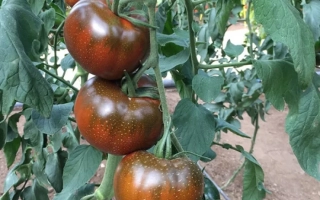


SKU #50276
·
47 views
BLUE LAGOON
Tomato
GavrishUser rating
0 votes0% positive reviews
No ratings yet — be the first.
Product Type
Seeds; Seed material
Plant Type
Indeterminate
Maturation Period
100-120 days
Fruit Weight
150 - 200 grams
Store offers · 13 from 10 stores
Prices are updated on loadLoading offers…
Available at: Agrodrug · Baza Proraba · Цибулинка · Foody · Kostiuk · Nasinynka · Райська Долина · Rodsad · Traskovskyi · Віста
Aggregator catalog: prices are collected automatically from store websites, normalized by AI and converted at the current exchange rate. Before ordering, confirm the price and availability on the store's website. This block is not indexed by search engines — the data is loaded after the page opens.
About product

The Blue Lagoon tomato is a medium-early indeterminate (tall) variety, developed through traditional selection and GMO-free. The plant forms clusters of 6-8 fruits per cluster, each weighing 160-190 grams. The fruits are distinguished by their unusual purple color, due to anthocyanin content, as well as a sweet taste and rich fruity aroma. Thanks to high antioxidant content, these tomatoes possess…
Product Type
Seeds; Seed material
Plant Type
Indeterminate
Maturation Period
100-120 days
Fruit Weight
150 - 200 grams
Description
The Blue Lagoon tomato is a medium-early indeterminate (tall) variety, developed through traditional selection and GMO-free. The plant forms clusters of 6-8 fruits per cluster, each weighing 160-190 grams. The fruits are distinguished by their unusual purple color, due to anthocyanin content, as well as a sweet taste and rich fruity aroma. Thanks to high antioxidant content, these tomatoes possess health-beneficial properties.
The Blue Lagoon variety is disease-resistant and has good storability, making it convenient for storage and transportation. The fruits are widely used in culinary applications, especially suitable for salads and pickling. For successful cultivation, seedlings should be sown in late February to early March, pinched in the first true leaf stage, and transplanted into greenhouses in late April to early May.
Cultivation agronomy includes mandatory staking of plants several days after transplanting, formation of a single-stem plant by removing all suckers and lower leaves, and topping the growth point at the end of the growing season. The recommended planting scheme is 40x60 cm, ensuring optimal conditions for tomato growth and fruiting.
The Blue Lagoon variety is disease-resistant and has good storability, making it convenient for storage and transportation. The fruits are widely used in culinary applications, especially suitable for salads and pickling. For successful cultivation, seedlings should be sown in late February to early March, pinched in the first true leaf stage, and transplanted into greenhouses in late April to early May.
Cultivation agronomy includes mandatory staking of plants several days after transplanting, formation of a single-stem plant by removing all suckers and lower leaves, and topping the growth point at the end of the growing season. The recommended planting scheme is 40x60 cm, ensuring optimal conditions for tomato growth and fruiting.
Video · 8 videos
Suggest a video →Crop & resistance
Crop
Specifications hover over for a hint about the specification
| Product Type | |
|---|---|
| Plant Type | |
|
Maturation Period
Maturation Period
Vegetation period from emergence to technical maturity 30-50 days. |
100-120 days |
|
Fruit Weight
Fruit Weight
Tomato fruits are classified by weight as: very small — less than 20 grams; small — 20 — 50 grams; medium — 50 — 100 grams; large — 100 — 200 grams; very large — more than 200 grams. |
150 - 200 grams |
|
Fruit Color
Fruit Color
The fruit color of tomato varieties is influenced by the combination of skin and flesh color. Some varieties have transparent skin, others — yellow. When combined differently, the fruits can acquire quite diverse colors. The fruit color is affected by pigments (lycopene) and thei... |
|
| Transportability | |
|
Storage
Storage
Depending on the variety characteristics, the storage period for heads may vary from one month for early varieties to eight months for late cabbage varieties. |
More than 30 days |
| Registration year | 2018 |
| Catalog | Catalog → Tomato |
| Manufacturer | Gavrish |
| Legal data |
Show · 4
|
| Country | Russia |
Not yet комментариев. Be the first!
Alternatives
Tomato seeds · similar varieties




See also
Often considered together with this variety




Recently viewed
Products you’ve viewed on this site
Reviews · 0