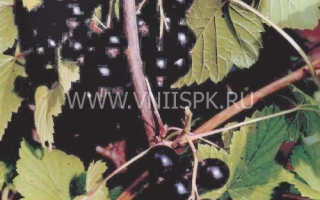
Medium-early maturing variety, developed at Pavlovsk Experimental Station of the All-Union Institute of Plant Growing named after N.I. Vavilov by crossing the varieties Minay Shmyrev and Ojebyn. Breeders: E.V. Volodina, S.P. Хотимская, O.A. Tikhonova. Included in the State Register of Varieties Approved for Use in the Northern, Northwestern, Central, and Far Eastern regions in 2007.
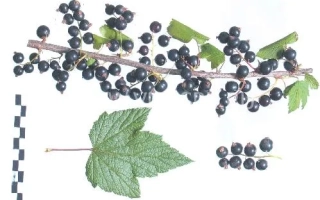
Bush is tall, medium-spreading, dense. Growing shoots are thick, straight, green, smooth, glossy, with barely noticeable hairs, with weak uneven anthocyanic coloring predominantly in the lower part. Woody shoots are brownish-brown with brown tips, thick, with slight tapering toward the tip, curved, glossy, weakly hairy. Buds are solitary, medium-sized, egg-shaped, with pointed tips, colored, pink or lavender, hairy, angled, terminal bud is not free, large, oval, with blunt tip. Leaf scars are wedge-shaped, rarely round-wedge-shaped.
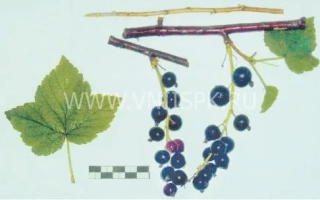
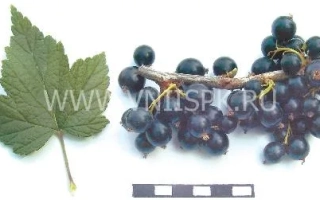
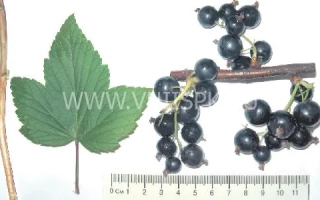
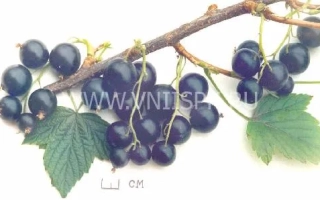
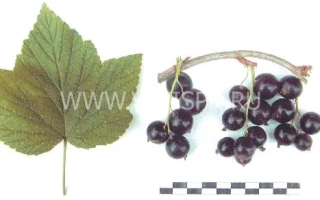
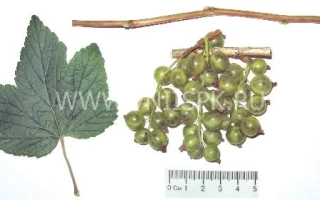
Leaf is five-lobed, medium to large, dark green, glossy, wrinkled, leathery, with sparse hair on main veins of upper and lower leaf surfaces. Leaf blade is concave along the midrib. Main veins are mostly uncolored, occasionally with barely noticeable anthocyanic coloring from base of leaf blade to midrib. Central lobe is significantly larger than lateral lobes, concave, egg-shaped or broad-egg-shaped, pointed, with weakly visible additional protrusions. Lateral lobes are short and medium, broad-egg-shaped, with pointed tips directed sideways or slightly angled, angle between their veins is straight. Basal lobes are weakly expressed, their veins spread out. Base has a medium or deep notch, heart-shaped, open or with a "button" at the top of the shoot. Due to raised edges of basal and lateral lobes and concavity of central lobe, terminal leaves appear like "funnels" or "bowls" (characteristic feature of the variety). Teeth are large, toothed, shallow, with well-defined but relatively short "claw". Leaf petiole is medium length, thick, green or unevenly colored, hairy along entire length, straight or slightly curved, directed at acute (60°) angle to shoot.
Flowers are medium-sized, cup-shaped, pink-magenta. Sepals are spatulate, with rounded tips, pink-magenta, hairy, twisted, free. Petals are egg-shaped with barely detectable anthocyanic coloring, slightly inclined toward pistil, touching each other. Stigmas are positioned above stamens. Ovule is bare, smooth, glandular-hairy, uncolored. Inflorescences are medium length (4.4–6.7 cm, 5–8 berries), stem medium thickness, green, with sparse hairs, petiole short or medium. Berry stalks are long, medium thickness, green, hairy.
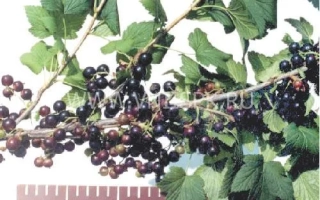
Berries are medium-large (0.9–1.1 g), round-oval, black, medium-glossy, with a large number (45) of medium and small seeds, with small, wide, closed, semi-deciduous, deciduous calyx. Flavor is sour-sweet (4.9 points), delicate, with a fine aroma. Chemical composition: dry matter — 20.7%, total sugars — 11.6%, titratable acidity — 2.6%, ascorbic acid — 178.1 mg/100 g.
Variety is highly winter-hardy, early-bearing, moderate self-fertility (yield higher with cross-pollination by other varieties), resistant to powdery mildew and leaf spots, moderately resistant to bud mite.
Advantages of the variety: excellent dessert flavor, dry berry detachment, medium-early ripening, resistance to fungal diseases.
Disadvantages of the variety: to obtain consistently high yields, presence of pollinating varieties is necessary.