


SKU #4406
·
158 views
Druzhnaya
Currant
User rating
0 votes0% positive reviews
No ratings yet — be the first.
Type of Sort
Blackcurrant
Store offers · 1 from 1 stores
Prices are updated on loadLoading offers…
Available at: Плодопитомник Сад
Aggregator catalog: prices are collected automatically from store websites, normalized by AI and converted at the current exchange rate. Before ordering, confirm the price and availability on the store's website. This block is not indexed by search engines — the data is loaded after the page opens.
About product

The variety was obtained at the Minusinsk Experimental Station for Horticulture and Melon Cultivation from crossing the varieties Primorsky Champion and Diploma. Authors: E.P. Kuminov, Yu.G. Leonova, I.M. Leonov, A.M. Baranova, Z.I. Starikova. Widely distributed in Western and Eastern Siberia, actively used in breeding crosses as a source of valuable traits.
The bush is weakly branched, sparse…
Type of Sort
Blackcurrant
Description
The variety was obtained at the Minusinsk Experimental Station for Horticulture and Melon Cultivation from crossing the varieties Primorsky Champion and Diploma. Authors: E.P. Kuminov, Yu.G. Leonova, I.M. Leonov, A.M. Baranova, Z.I. Starikova. Widely distributed in Western and Eastern Siberia, actively used in breeding crosses as a source of valuable traits.
The bush is weakly branched, sparse, and low-growing. Growing branches are medium-sized, curved, green, with weak anthocyanin coloration along their entire length, hairy. Woody branches are of medium thickness, light-brown in color with a slight anthocyanin "tan" on the sun-exposed side. Buds are medium-sized, egg-shaped, with a pointed apex, light-green, weakly anthocyanin-colored, densely hairy, lateral, single, leaf scar shape rounded-lobed.
The leaf is three-lobed, large, light-green, matte, with weak hairiness, wrinkled, leathery, blade slightly concave along midveins. The central lobe is broad, exceeding the lateral lobes, apex acute. Lateral lobes are of medium length, broad, apexes acute, directed sideways, angle between veins of lateral lobes obtuse. Leaf base slightly open, often overlapping, no hair, with deep notch. Teeth are medium-sized, apex of teeth with "claw-like" shape, veins not colored. Leaf petiole is medium-sized, thin, no hair, green, positioned on the branch at an acute angle.
Flowers are medium-sized, sepals dark-pink, loosely arranged. Inflorescences are long and dense. Axis is thick, petiole short, hairless.
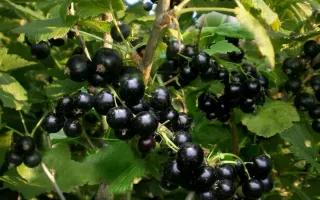
Berries are large (1.3-1.6 g), round, black, with dry detachment, with medium seed count, thick skin. Receptacle is closed, medium-sized, non-decaying, pedicel short, green, hairless. Flavor is sour-sweet, with aroma (4.9 points). Berries are of universal use. Chemical composition: dry soluble substances — 13.7%, sugar sum — 10.3%, titratable acidity — 2.1%, ascorbic acid — 186.0 mg/100 g.
The variety is highly winter-hardy, moderately drought-resistant, heat-tolerant, yield 6.4 t/ha (1.7 kg/plant), with good self-fertility (up to 39%), resistant to powdery mildew, anthracnose, septoria, and bud mite.
Advantages of the variety: winter hardiness, drought resistance, simultaneous berry ripening, comprehensive resistance to major pests and diseases. Suitable for dense planting.
Disadvantages of the variety: weak branching capacity.
Crop & resistance
Crop
Disease resistance
Pest resistance
Specifications
| Type of Sort | |
|---|---|
| Catalog | Catalog → Currant |
Not yet комментариев. Be the first!
Alternatives
Currant saplings · similar varieties




See also
Often considered together with this variety



Recently viewed
Products you’ve viewed on this site
Reviews · 0