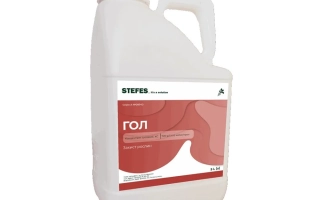
GOAL 2E — non-systemic selective herbicide for pre- and early post-emergence application to control most broadleaf and some grassy weeds; available as an emulsifiable concentrate containing 240 g/l of oxyfluorfen.
GOAL 2E is registered worldwide for use on onion, sunflower, ornamental plants, cabbage, sugar cane, fruit orchards, forest plantations, cotton and many other crops.
Mode of action and application.
GOAL 2E belongs to the group of herbicides whose effect on plants depends on the presence of sunlight.
The mechanism of action is based on disrupting chlorophyll synthesis and damaging cell membranes.
GOAL 2E acts through two different mechanisms.
When applied to seedlings before weed emergence, GOAL 2E remains almost immobile in soil and is not washed away by water, forming a herbicide barrier on the soil surface that inhibits weed development until its integrity is broken. Soil treatment after application reduces herbicide activity.
When applied to seedlings after weed emergence, GOAL 2E kills weeds by acting as both a contact herbicide and a soil herbicide, reaching the soil surface. It is more effective when applied to actively growing plants with a minimum application rate of 300 l/ha.
Herbicide activity of the barrier lasts up to 3 months.
More effective on soils with low organic matter (humus) content.
Base unit
5 L.
Spectrum of activity.
GOAL 2E will help eliminate the most persistent weeds on onion, sunflower, cabbage and fruit crops, specifically: Ambrosia artemisiifolia, chickweed, white mustard, creeping thistle, docks, chamomile, Veronica, Galinsoga parviflora, wild mustard, common ragweed, Teucrium theophrasti, portulaca oleracea, wild radish, medicinal camomile, shepherd's purse.
GOAL 2E is sufficiently effective against field bindweed, oats, field bindweed (annual), and Polygonum multiflorum.
Less effective against common sowthistle and middle starwort.
Registration and recommended application rates.
Onion — 0.5-1.0 L/ha against annual weeds. Spraying can be done either before crop emergence or in the 1-2 leaf stage.
Sunflower — 0.8 — 1.0 L/ha against annual weeds. Soil application after sowing but before crop emergence. Heavy rainfall may cause slight phytotoxicity on early crop leaves, which does not affect crop development or yield. Working fluid application rate — 300-500 L/ha.
Apple — 4.0-5.0 L/ha against annual broadleaf weeds. Targeted spraying of actively growing weeds in spring at 10-15 cm height.
Annual plantings of spruce, pine, and larch (in nurseries) — 2.0-4.0 L/ha for pre-emergence soil treatment against annual weeds; 3.0-4.0 L/ha for post-emergence treatment after seedling growth has ceased; 6.0-8.0 L/ha at the beginning or after completion of seedling and sapling growth.
GOAL 2E is non-toxic to birds, bees, and soil invertebrates. Highly toxic to fish and other aquatic organisms.
Retail sale to the public is permitted for use on onion crops at a rate of 5-10 g per 6-8 L of water per 100 m².