


SKU #4038
·
193 views
Salamatovskaya
Cherry, Sour Cherry
User rating
0 votes0% positive reviews
No ratings yet — be the first.
Type of Sort
Steppe Cherry
About product

Obtained from seedlings of selected forms of steppe cherry, pollinated freely. Originator — Central Siberian Botanical Garden, SB RAS. Authors: M.N. Salamatov, V.S. Simagin, V.P. Belousova. Undergoing State Variety Testing since 1995. The bush is small, 1–1.5 m tall, medium density, densely branched. Bark of the trunk is smooth, grayish-brown. Growing shoots are upwardly curved, slightly bent, gr…
Type of Sort
Steppe Cherry
Description
Obtained from seedlings of selected forms of steppe cherry, pollinated freely. Originator — Central Siberian Botanical Garden, SB RAS. Authors: M.N. Salamatov, V.S. Simagin, V.P. Belousova. Undergoing State Variety Testing since 1995.
The bush is small, 1–1.5 m tall, medium density, densely branched. Bark of the trunk is smooth, grayish-brown. Growing shoots are upwardly curved, slightly bent, greenish-light brown, light gray the next year, with few lenticels, yellow-gray, small. Vegetative buds are oval-pointed, generative buds are oval, moderately set back from the shoot. Leaves are inversely egg-shaped, 5 x 2.5 cm, light green; apex rounded, base wedge-shaped, serration regular; leaf blade folded like a boat, slightly curved, smooth, glossy, not pubescent underneath; glands at the base of the blade, small, 2–3 per leaf; petiole 1.6 cm long, medium thickness, green. Flowers in umbels of 4–5, 24 mm in diameter, corolla saucer-shaped, petals nearly closed, white; stigma slightly above stamens; calyx cup-shaped, calyx lobes round-triangular, without teeth; stamens 12 mm long, stigma 15 mm long. Flowers on one-year-old shoots and flower clusters.
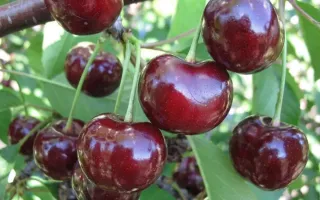
Fruit weight 2.2–2.7 g, height 18 mm, width 17 mm, thickness 15 mm; oval-gourd-shaped, no depression, apex rounded; skin color bright red, solid; flesh color light red, juice light red; flesh tender, juicy; pedicel 2.7 cm long, thin; stone oval-gourd-shaped, weight 0.13–0.15 g, about 5% of fruit weight, apex rounded, base elongated, good detachment from flesh. Fruits attractive in appearance, uniform; flesh juicy. Flavor sour-sweet with slight bitterness, satisfactory. Fruits contain 14.9% dry matter, 11.8% sugars, 0.97% free acids, 19 mg/100g ascorbic acid. Good fruit detachment. Suitable for harvesting with berry harvesters. Fruits resistant to cracking. Universal variety. Suitable for high-quality jam, compote, juice, and fresh consumption.
Flowering is medium-late, in Novosibirsk at the end of May — beginning of June; ripening is medium, after July 25, prolonged; enters fruiting on 3–4 years after planting. Propagated by green cuttings and suckers, lifespan of trunk 10–11 years. Self-sterile, well pollinated by 'Serdtchko' variety and other simultaneously blooming forms of steppe cherry. Fruit production is regular and abundant. Yield 4–6 kg per bush, at planting distance 3 x 1.5 m yields about 85–130 c/ha.
Mature wood, young shoots, and generative buds are highly resistant to winter frosts; flowers are moderately resistant to spring frosts. High drought resistance, moderate heat tolerance. Weakly resistant to coccomyces, moderately resistant to moniliosis, resistant to clasterosporiosis and witches’ broom, resistance to bacterial, viral, and mycoplasma diseases not studied. Weakly affected by gummosis and chlorosis. Moderately damaged by cherry aphid, cherry sawfly, cherry and bird cherry scale insects, plum fruit moth; resistance to other pests not studied. Suitable for intensive orchards.
Advantages of the variety: high winter hardiness and yield, suitability of fruits for various processing, late flowering.
Disadvantages of the variety: small fruits, self-sterility, insufficient resistance to coccomyces and clasterosporiosis.
Crop & resistance
Crop
Disease resistance
Specifications
| Type of Sort | |
|---|---|
| Catalog | Catalog → Cherry, Sour Cherry |
Store offers
Prices are updated on loadLoading offers…
Aggregator catalog: prices are collected automatically from store websites, normalized by AI and converted at the current exchange rate. Before ordering, confirm the price and availability on the store's website. This block is not indexed by search engines — the data is loaded after the page opens.
Not yet комментариев. Be the first!
Alternatives
Cherry saplings · similar varieties


See also
Often considered together with this variety




Recently viewed
Products you’ve viewed on this site
Reviews · 0