
Triseti mosaic
Tritimovirus triseti
The causative agent of this disease is the Triseti mosaic virus (Tritimovirus triseti), a member of the Tritimovirus genus within the Potyviridae family. It is a filamentous virus that targets various cereal species.
What the section contains
Triseti mosaic
The virus is primarily transmitted by the eriophyid mite Abacarus hystrix. These mites acquire the virus while feeding on infected plants and then transmit it to healthy hosts.
Natural reservoirs for the virus include wild perennial grasses, such as quackgrass, where the pathogen persists throughout the year, serving as a source for primary infection.
The biology of the virus is strictly linked to the lifecycle and migration patterns of the mite vector. Wind currents facilitate the movement of these vectors over large distances.
Molecular studies confirm that the virus is closely related to other tritimoviruses, which necessitates rigorous phytosanitary monitoring in cereal-producing regions.
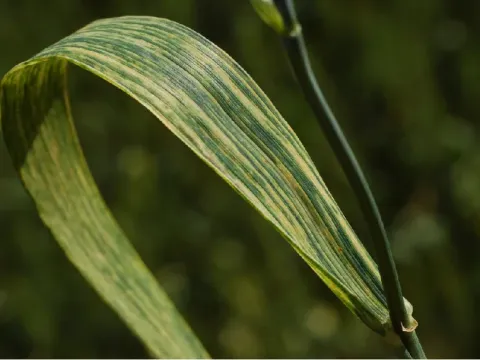
The early symptoms of Triseti mosaic manifest as light-green or yellow chlorotic streaks and stripes along the leaf veins. As the infection progresses, these develop into a distinct mosaic pattern.
Infected plants often exhibit significant stunting and reduced biomass compared to healthy individuals. The overall growth is inhibited, leading to a noticeable reduction in height.
Severe infections disrupt the photosynthetic capacity of the leaves, causing premature yellowing and tissue necrosis. This reduction in chlorophyll directly impacts the plant's ability to fill the grain.
Deformation of the leaf blades, including curling or twisting, is a common indicator of viral impact. Such morphological changes signal metabolic distress in the affected host.
- Chlorotic striping on young leaves.
- General plant stunting and reduced vigor.
- Poor tillering and reduced field density.
- Deformed or shriveled ears and grain spikes.
Favorable weather conditions for the mite vector, specifically warm and dry periods, significantly increase the risk of disease spread. Mite activity peaks during such meteorological conditions.
The proximity of wild grass hosts creates a "green bridge" that allows the virus to move easily into cultivated fields. Improper sanitation near field edges exacerbates the risk.
Dense crop stands can foster a microclimate that supports rapid mite colonization. When coupled with high vector populations, the virus can quickly disseminate throughout a field.
Temperature influences both the virus incubation period and the biological activity of the mite. Seasonal patterns play a crucial role in determining the severity of annual outbreaks.
Agricultural management, including the lack of crop rotation and improper field isolation, allows the virus to persist and accumulate in the ecosystem over multiple seasons.
The primary economic impact of Triseti mosaic is a significant reduction in grain yield. Infected plants produce smaller, shriveled kernels, which lowers the overall harvest quality.
Uneven ripening caused by the disease can lead to complications during the harvesting process. Additionally, the weakness of the stems increases the risk of lodging.
In cases of early-stage infection, complete plant mortality can occur, forcing growers to re-seed affected areas. This leads to increased input costs and potential financial loss.
Viral infection weakens the plant's natural immune response, leaving it susceptible to secondary infections by various fungi and bacteria, which complicates the health of the crop.
The cumulative loss from poor yield and quality makes this virus a serious concern for cereal production, often requiring significant adjustments in management strategies.
The most effective management practice is the removal of weed hosts and volunteers in the off-season. Controlling perennial grasses around field perimeters helps limit vector populations.
Maintaining proper spatial isolation between early-sown and late-sown cereals is crucial to prevent the migration of the virus into emerging crop stages.
Selecting and planting resistant or tolerant cereal cultivars is the best long-term strategy for mitigating disease impact. Breeding efforts focus on identifying genotypes with high resistance.
Chemical control of mite vectors can be implemented if pest pressure is high; however, its efficacy is often limited by the rapid movement of the mites and timing challenges.
Adopting an integrated pest management (IPM) approach, which combines cultural practices with careful monitoring, provides the best defense against the spread of Triseti mosaic.