
Tritimovirus
Tritimovirus
Description
Symptoms
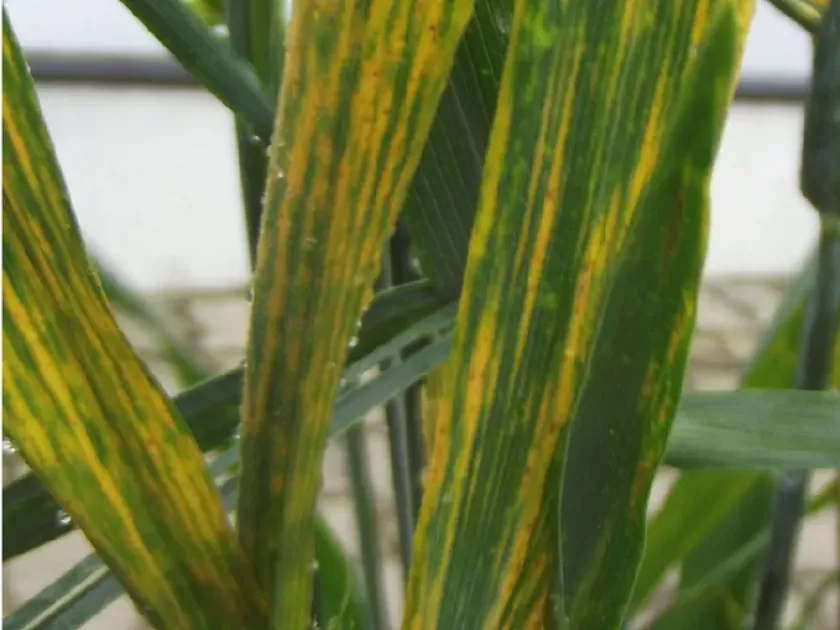
The defining clinical sign of a tritimovirus infection is the appearance of yellow, mosaic-like streaks on the leaves. These patterns usually run parallel to the leaf veins and can eventually cover the entire leaf surface.
Infected plants exhibit a distinct stunted growth and may appear bushy due to excessive and abnormal tillering. This morphology is often referred to as a rosette appearance in severe cases.
Reproductive development is severely compromised; heads may fail to emerge correctly or may be completely sterile. If grains are produced, they are typically shriveled, lightweight, and of poor quality.
Leaves on infected plants may show premature chlorosis, followed by necrosis as the season progresses. The disease is often patchy within a field, appearing as areas of yellowed, stunted plants near the edges of fields where mites initially landed.
Because these visual symptoms can mimic nutrient deficiencies or other viral diseases, accurate identification often requires laboratory diagnostics like ELISA or RT-PCR tests.
Pathogen
The genus Tritimovirus belongs to the family Potyviridae and includes several significant plant viruses, most notably the Wheat streak mosaic virus (WSMV). These viruses have a filamentous morphology and carry a positive-sense single-stranded RNA genome.
The host range of tritimoviruses primarily includes cereal crops such as wheat, corn, barley, and millet. They also thrive in various wild grass species, which serve as essential reservoirs for the virus during the off-season.
Transmission occurs exclusively through the eriophyid mite Aceria tosichella. These microscopic arthropods act as both vectors and hosts, acquiring the virus by feeding on infected plant tissue.
Once a mite acquires the virus, it remains a vector for the rest of its life cycle. The mites are easily picked up by wind currents, allowing for the widespread dissemination of the virus to healthy fields.
The virus replicates within the host cell and spreads systemically through the phloem. It interferes with fundamental physiological processes, including chlorophyll production and starch accumulation, leading to severe plant damage.
Conditions for development
The development of a tritimovirus outbreak is heavily dependent on the population dynamics of the mite vector. Mild winters and warm, moist springs provide ideal conditions for mite reproduction and survival.
The "green bridge" is the most critical factor for the virus's persistence. This refers to the presence of volunteer wheat or grassy weeds that bridge the gap between harvest and the emergence of new fall crops.
High temperatures and drought in late summer force mites to migrate from maturing crops onto newly emerged seedlings. This period of migration poses the highest risk for large-scale field infection.
Early planting of winter cereals creates a perfect scenario for early-season infections, as young seedlings are highly vulnerable to the viruliferous mites settling on them.
The prevalence of wind-borne mite transport means that even distant sources of infection can lead to rapid spread within a field if meteorological conditions are favorable for wind-mediated dispersal.
Why it matters
Tritimoviruses are among the most economically damaging viruses in cereal production. Yield losses can be catastrophic, ranging from moderate reductions to total crop failure in susceptible fields.
Beyond quantity, the quality of the grain is severely downgraded. Test weight decreases significantly, and the milling and baking quality of the wheat is impaired, resulting in lower market prices.
Infection during the early growth stages significantly decreases the survival rate of seedlings throughout the winter months, leading to thin and uneven stands that fail to reach their full potential.
Plants affected by the virus are more susceptible to secondary stresses, including root rot diseases and cold injury, which further complicates the health of the cereal crop.
Because there is no curative treatment for viral diseases once a plant is infected, the economic harm is permanent and often necessitates replanting or complete loss of the affected acreage.
Protection
The primary management strategy is the elimination of the "green bridge." This involves tilling under volunteer wheat and controlling grass weeds at least two weeks before planting new crops.
Adjusting the planting date is a proven tactic; delaying planting of winter wheat reduces the likelihood of mites settling on young, susceptible seedlings during the peak migration window.
Selecting and planting virus-resistant or tolerant cultivars is the most effective long-term method for mitigating the risks associated with tritimoviruses.
Spatial isolation is also important; growers should try to avoid planting new fields adjacent to fields that currently harbor host weeds or are infested with mites.
While chemical control of mites with acaricides is theoretically possible, it is rarely cost-effective or practical in field-scale agriculture, reinforcing the need for proactive cultural control methods.
Discussion
No discussions yet — be the first.