
Poacevirus
Poacevirus
Poacevirus is a genus of plant viruses within the Secoviridae family. These pathogens are known to infect various monocotyledonous plants, with a significant impact on species within the Poaceae family.
What the section contains
Poacevirus
The virus consists of a single-stranded RNA genome enclosed in a protein capsid. It operates as an obligate intracellular parasite, forcing the host plant to replicate the viral RNA during its metabolic processes.
Poaceviruses are typically transmitted by insect vectors. The virus particles are acquired by insects such as aphids or leafhoppers when feeding on infected plant sap and then injected into healthy plants during subsequent feedings.
Once inside the host, the virus spreads through the phloem, causing systemic infection. This spread impairs the plant's ability to move nutrients efficiently, affecting its growth and development.
The virus is often found in wild perennial grasses, which serve as natural reservoirs, ensuring the survival and persistence of the pathogen in the environment even in the absence of crop hosts.
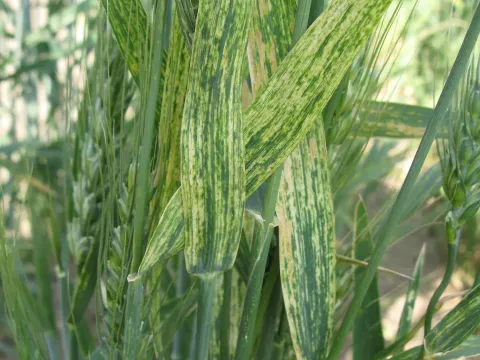
The characteristic signs of a Poacevirus infection include leaf chlorosis and mosaic patterns. These manifest as irregular light-green or yellow stripes running parallel to the leaf veins.
Stunting is a very common clinical sign of this disease. Infected plants often exhibit shortened internodes and a general reduction in overall plant height compared to healthy neighboring plants.
In addition to stunting, leaves may become distorted, curled, or show premature chlorotic tip dieback. Such symptoms can sometimes be mistaken for nitrogen deficiency or drought stress.
Infected crops often display abnormal tillering, resulting in a dense but weak appearance of the plant canopy. The plants fail to develop normal vegetative architecture.
The most detrimental sign is observed during the reproductive stage. Infected plants produce small, underdeveloped spikes, often resulting in empty glumes or severely shriveled, low-quality grains.
The primary factor for Poacevirus development is the activity of its insect vectors. Weather patterns that favor the reproduction and movement of aphids and leafhoppers significantly increase infection risks.
Warm springs or mild winters contribute to high populations of insect vectors, which then migrate from wild grasses (reservoirs) to newly emerged or actively growing crop fields.
Agronomic practices, such as failing to control weeds around fields, play a major role in the spread. These weeds act as a steady source of the virus throughout the growing season.
Environmental stress, including extreme temperatures or soil moisture imbalances, can weaken plant defenses. Once the plant's immune system is compromised, it becomes significantly more susceptible to viral invasion.
Continuous cropping of susceptible cereal species on the same field promotes the build-up of the virus in the local ecosystem, making disease management progressively harder over time.
The economic harm caused by Poacevirus is primarily linked to significant yield losses. Infected crops produce less grain, and the quality of the harvested produce is often too poor for commercial standards.
Viral infection disrupts photosynthesis and carbohydrate transport, leading to reduced grain filling. This results in lower bushel weights and diminished industrial quality of the cereal grains.
Plants affected by Poacevirus are prone to secondary infections by fungal pathogens due to their weakened physiological state, which can lead to crop failure or widespread death of seedlings.
Control costs represent a major financial burden for growers, as frequent insecticide applications are required to manage insect vectors and prevent the virus from spreading across the field.
In regions where the virus is endemic, the necessity to abandon certain varieties or switch to less profitable crops creates long-term financial uncertainty for agricultural producers.
Effective control of Poacevirus revolves around managing insect vector populations. Early application of systemic insecticides is a standard practice to reduce the number of insects feeding on crops.
Spatial isolation of fields from areas with high populations of wild grasses is a critical preventive measure. Keeping fields clean of volunteer plants and weeds is essential for breaking the infection cycle.
Adopting resistant or tolerant crop varieties is the most sustainable approach to managing the disease. Breeding programs focus on enhancing plant immunity to inhibit viral replication.
- Regular monitoring of fields for the presence of vectors and initial mosaic symptoms.
- Strict adherence to recommended planting dates to avoid vector peak activity.
- Use of certified, virus-free seeds for every planting season.
- Integrated pest management (IPM) to maintain low levels of insect pressure.
If infection is detected, rogueing (removal of infected plants) can be effective in small-scale farming to prevent the spread to the rest of the field before it reaches epidemic proportions.