
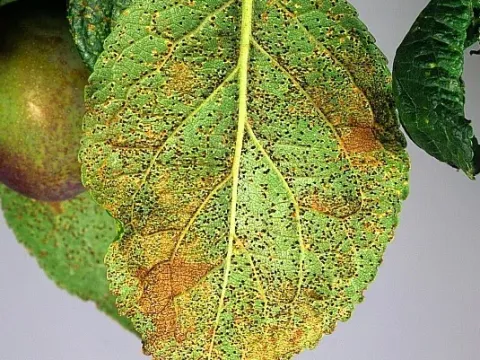
Plum rust
Plum rusty
Plum rust is a fungal disease caused by the pathogen Tranzschelia pruni-spinosae (formerly Puccinia pruni-spinosae), a member of the Basidiomycota phylum.
What the section contains
Plum rust
The fungus is an obligate parasite with a heteroecious lifecycle, requiring an alternate host, typically plants in the Ranunculaceae family like Anemone species, to complete its development.
The fungus develops uredinia and telia on the underside of plum leaves, which are responsible for the dispersal of spores throughout the growing season.
The pathogen primarily overwinters as teliospores on fallen, infected leaves that accumulate on the orchard floor, providing a primary inoculum source in early spring.
As a parasite, it exploits the tree's physiological processes, diverting nutrients away from the host and severely hampering the photosynthetic capacity of the leaves.
Symptoms typically appear in mid-to-late summer, starting as small, pale yellow or light green spots on the upper surface of the leaves.
On the corresponding underside of these spots, characteristic reddish-brown, pustule-like fruiting bodies (uredinia) begin to develop as the infection progresses.
These rusty-colored pustules can become very numerous and eventually coalesce, covering a significant portion of the leaf surface and causing severe damage.
Heavy infections lead to premature yellowing of the foliage, leaf curling, and early leaf drop, which often results in bare branches long before the natural dormancy period.
While the disease mainly targets leaves, severe outbreaks can sometimes impact young, tender shoots, causing stress and weakening the overall vitality of the tree.
The development of Plum rust is heavily favored by warm, humid weather conditions, especially when high moisture levels persist during the summer months.
Optimal temperatures for spore germination and infection are generally between 18°C and 25°C, making warm summers particularly conducive to rapid disease spread.
Poor orchard ventilation due to dense canopy growth or inadequate pruning practices increases the humidity around the foliage, promoting spore establishment.
Presence of alternate host plants in the immediate vicinity of the orchard significantly increases the risk of early and severe disease outbreaks each spring.
Environmental stress, combined with poor cultural practices like improper irrigation or excessive weed growth, further suppresses the tree's natural defense mechanisms.
The primary impact of Plum rust is the premature loss of foliage, which prevents the tree from storing essential energy reserves before entering the winter period.
This early defoliation drastically reduces winter hardiness, making the trees much more susceptible to frost damage and winter kill of terminal buds.
Crop quality is significantly compromised; infected trees often produce smaller, inferior fruit with lower sugar content and poorer flavor profile.
Chronic annual infections lead to overall tree decline, stunted growth, and a marked reduction in yield, sometimes resulting in total loss of the harvest.
Over time, the cumulative impact of the disease reduces the tree's productive lifespan and makes it increasingly vulnerable to other secondary pests and pathogens.
- Sanitation: Rake and remove all fallen leaves from the orchard to eliminate overwintering spores.
- Pruning: Implement thinning cuts to improve canopy airflow and light penetration, reducing leaf moisture.
- Fungicides: Apply copper-based or systemic fungicides as a preventative measure during high-risk weather windows.
- Orchard hygiene: Manage weeds and alternate hosts near the orchard to reduce the initial spore load.
- Monitoring: Conduct regular inspections of the leaves starting in early summer to detect and treat early infections.