
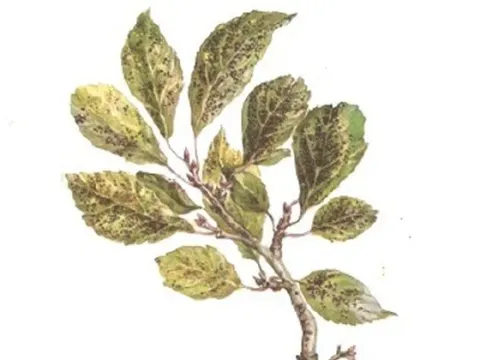
Plum rust
Cherry european
The first symptoms of plum rust appear in mid-summer as small, light-green or yellowish angular spots on the upper surface of the leaves.
What the section contains
Plum rust
On the undersides of these spots, rust-colored or brownish-red pustules containing urediniospores emerge, which disperse easily when disturbed.
As the season progresses toward autumn, dark brown to black teliospores develop on the lower leaf surface, marking the final stage of the pathogen's development.
Severe infections result in premature yellowing and heavy leaf drop, which often leaves the tree bare well before the natural dormant season.
In humid conditions, the pathogen may also affect young shoots and fruits, causing small, dark, scabby lesions that impact fruit quality.
The disease is caused by the basidiomycete fungus Tranzschelia pruni-spinosae, a specialized plant pathogen that targets stone fruit trees.
This fungus is heteroecious, meaning it requires two unrelated hosts to complete its complex life cycle: a species of Prunus and a species of anemone.
The fungus overwinters primarily in infected fallen leaves as teliospores, which are highly resistant to cold weather and environmental stressors.
During the spring, these spores germinate and infect the alternate host (anemone), eventually completing the cycle by spreading back to plum trees.
The multi-stage spore production strategy makes this fungus a highly persistent threat capable of rapid adaptation within the orchard environment.
Plum rust development is heavily dependent on moisture; frequent rains, heavy morning dews, and high humidity provide ideal conditions for spore germination.
Temperatures ranging from 18 to 24 degrees Celsius are considered optimal for the rapid colonization and reproduction of the pathogen.
Poor orchard hygiene, such as dense canopy growth or lack of pruning, limits airflow and traps moisture, which accelerates the spread of the infection.
The spores are efficiently distributed over long distances by wind, while localized spread within the tree is often aided by splashing rainwater.
Late summer periods characterized by warm, wet weather often trigger widespread outbreaks, turning a manageable issue into a significant orchard problem.
The primary damage is caused by extensive defoliation, which severely disrupts photosynthesis and reduces the tree's ability to store carbohydrates.
Weakened trees suffer from reduced winter hardiness, making them significantly more susceptible to frost damage and potential branch dieback.
Yield capacity for the following year is compromised, as the tree lacks the energy reserves necessary to produce healthy flower buds.
Fruit quality is diminished; affected fruits may remain small, have lower sugar content, and exhibit poor color, reducing their commercial marketability.
Chronic infestation weakens the overall physiological health of the tree, creating entry points for secondary wood-rotting diseases.
Sanitation is the cornerstone of control; raking and destroying all fallen leaves in autumn is critical to remove the primary source of overwintering inoculum.
Pruning should be focused on opening the canopy to ensure adequate light penetration and air circulation, thereby reducing the duration of leaf wetness.
Preventative applications of copper-based fungicides during the dormant period and early spring can significantly lower the initial infection pressure.
During the growing season, if symptoms are detected, the use of systemic fungicides from the triazole or strobilurin classes is highly recommended.
- Maintain spatial isolation from wild or cultivated anemone patches.
- Implement a balanced fertilization program to boost tree vigor and natural resistance.
- Select plum varieties with known resistance or tolerance to fungal pathogens.