

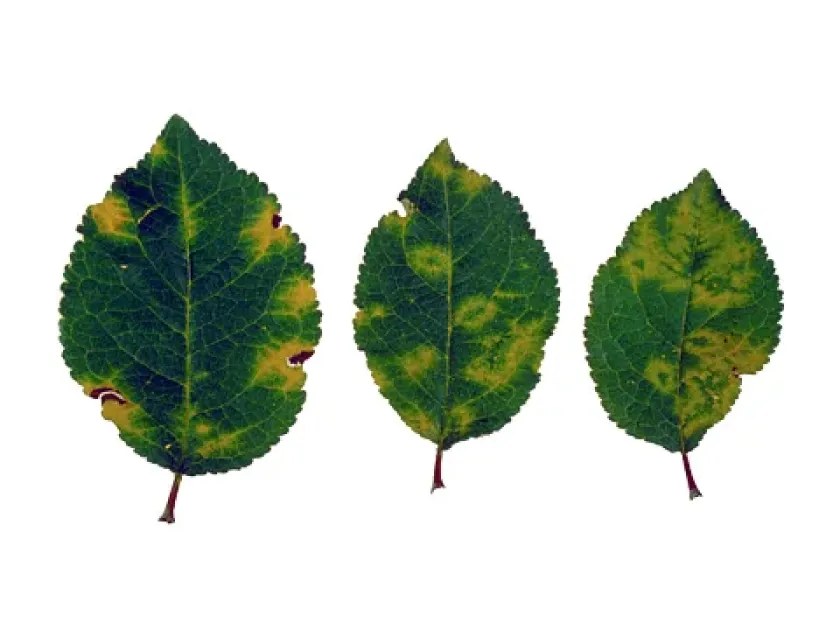
Description
Symptoms
Symptoms are most clearly expressed on leaves and fruits during the active growing season. The intensity of symptoms varies depending on the cultivar's susceptibility and environmental conditions.
Leaf symptoms typically manifest as chlorotic spots, light green rings, or wavy lines that become visible when leaves are held against the light. Heavy infections may lead to a distinct mosaic pattern.
Fruits are the most visibly affected organ, displaying depressed dark spots, rings, or bands. In severe cases, the fruit skin becomes deformed, and the flesh beneath turns reddish and necrotic.
Premature fruit drop is a common consequence of infection, significantly reducing the marketable yield and quality of the remaining harvest.
In many plum varieties, characteristic light-colored rings or blotches on the pits (stones) are reliable diagnostic indicators of a virus infection.
Pathogen
The causative agent of the disease is the Plum pox virus (PPV), which is a member of the Potyvirus genus. It is considered one of the most economically damaging viruses affecting stone fruit species, including plums, apricots, peaches, and nectarines.
The virus consists of flexuous rod-shaped particles containing a single-stranded RNA. It systemically infects the entire host plant, causing disruptions in metabolic processes and weakening the tree over time.
Transmission occurs primarily through two channels: infected planting material, such as buds, scions, or rootstocks, and various species of aphids that act as vectors.
PPV exhibits significant genetic diversity, with several distinct strains characterized by different host ranges and varying levels of virulence in the field.
Due to its high potential for economic devastation, Plum pox is classified as a regulated quarantine pest in most countries worldwide, requiring strict phytosanitary measures.
Conditions for development
The spread of PPV within an orchard is heavily dependent on the activity of aphid vectors, which acquire the virus while feeding on infected trees and transmit it to healthy ones.
Favorable weather conditions, such as warm and humid spring and early summer periods, accelerate the population growth of aphids, thereby increasing the risk of secondary transmission.
The virus can also be spread through contaminated horticultural tools if they are used for pruning or grafting without proper disinfection between trees.
Wild or neglected stone fruit trees often serve as asymptomatic reservoirs of the virus, facilitating its introduction and persistence in commercial orchard areas.
Long-distance dissemination is almost exclusively linked to the movement of infected nursery stock, highlighting the importance of certified and virus-tested material.
Why it matters
Plum pox is recognized globally as the most devastating viral disease of stone fruits, capable of causing nearly total loss of fruit production in highly susceptible orchards.
Infected fruits suffer from reduced sugar content, poor flavor, and flesh abnormalities, making them completely unsuitable for fresh consumption or commercial fruit processing.
The virus induces progressive weakening of the tree, leading to reduced vigor, sparse foliage, and increased susceptibility to secondary stressors like winter injury or other pathogens.
Economic losses arise not only from reduced yield but also from the mandatory destruction of orchards in order to curb the spread of the virus to disease-free zones.
Phytosanitary restrictions imposed by the presence of Plum pox often disrupt international trade and limit the export potential of fruit-producing regions.
Protection
The primary control strategy is prevention through the use of virus-indexed, certified nursery stock, which ensures that new plantings are starting disease-free.
Integrated orchard management must include rigorous sanitation, such as cleaning and disinfecting grafting knives and pruning equipment to prevent mechanical transmission.
Active monitoring and control of aphid populations are essential to minimize the vector-mediated spread of the virus within the orchard and from adjacent areas.
Immediate eradication of infected trees is necessary when symptoms appear, which involves the removal and destruction of the entire plant, including the root system, to eliminate the viral source.
- Utilize only certified pathogen-tested planting material.
- Implement strict orchard sanitation and tool disinfection.
- Establish buffer zones around affected orchards.
- Monitor regularly for vector activity and early symptoms.
Content graph
Connections · Plum pox
Most often together:
Categories
1 contact
Marketplace
Products · 1
Community
Discussion
No discussions yet — be the first.