
Maize streak disease
Mastrevirus striatis
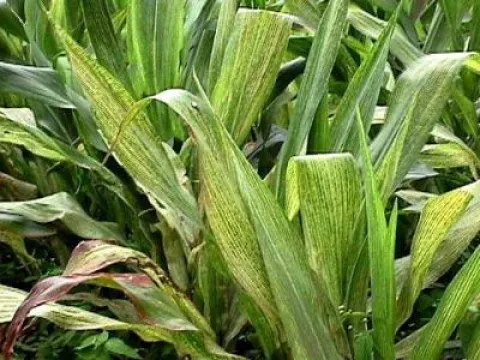
The primary symptom of the disease is the appearance of narrow, pale yellow chlorotic stripes that run parallel to the veins of the leaf. Over time, these stripes extend along the leaf, creating a distinct mosaic pattern.
What the section contains
Maize streak disease
Plants infected at early growth stages show severe stunting. The internodes are shortened, and the overall plant height is significantly lower than that of healthy crops, leading to uneven stands.
Generative development is heavily impacted. Tassels often fail to emerge properly or are deformed, which drastically reduces pollination efficiency and grain set.
Cobs on diseased plants are usually stunted, thin, and irregular. In severe cases, the plant may fail to produce any cobs at all, leading to total yield loss for that plant.
Leaves of infected plants eventually lose turgor, become brittle, and show signs of necrosis as the virus interferes with normal physiological processes and photosynthetic capacity.
The disease is caused by the Maize streak virus (MSV), a member of the genus Mastrevirus within the family Geminiviridae. It is a single-stranded DNA virus.
The virus cannot be transmitted mechanically through contact or through seeds. It relies entirely on a specific insect vector for transmission between host plants.
The main vectors are leafhoppers of the genus Cicadulina. These insects acquire the virus by feeding on infected plant sap and remain carriers throughout their lifespan.
The virus circulates within the vector's body, allowing leafhoppers to spread the disease across fields during their migratory phases, often triggered by changing weather conditions.
The host range is wide, including various grasses, wheat, barley, and sorghum. These plants act as primary reservoirs for the virus, especially during the off-season when corn is not growing.
The spread of the virus is closely linked to the population dynamics of the Cicadulina leafhoppers, which thrive in warm and relatively dry weather conditions.
The presence of infection sources such as wild grasses or volunteer maize plants near the fields is a major factor in initiating early-season outbreaks.
Early planting dates can sometimes allow corn to reach a stage of partial resistance or bypass the peak migration period of the leafhopper vector.
Temperature plays a vital role in viral replication rates. Higher temperatures generally accelerate the manifestation of mosaic symptoms once the plant has been inoculated.
Cultural practices, such as weed control and crop rotation, directly influence the environment for leafhoppers, determining whether they can successfully colonize a field.
The economic impact of the disease is driven by the significant reduction in photosynthetic rate, which directly correlates to a sharp decrease in grain yield and biomass.
Yield losses can range from 30% to over 80% in susceptible varieties. If infection occurs early in the vegetative phase, the financial loss is usually near total.
Grain quality is negatively affected, resulting in smaller, shriveled kernels with lower starch content and reduced nutritional value, making them less marketable.
Infected plants exhibit weakened structural integrity and immunity, making them highly susceptible to secondary pathogens like stalk and ear rots.
Harvesting becomes difficult in fields with high infection rates due to uneven maturity, lodging of weakened stems, and the overall reduction in crop uniformity.
The most effective strategy for managing maize streak disease is the use of resistant or tolerant maize hybrids, which significantly limits the impact of the virus.
Managing weed reservoirs, particularly perennial grasses near fields, is crucial to reducing the primary inoculum source for the leafhoppers.
Applying systemic insecticides at planting or during the early vegetative stage can help control leafhopper populations and delay the onset of viral transmission.
Staggering planting dates and maintaining spatial isolation between old and new fields helps prevent the transfer of the virus from source plants to susceptible young seedlings.
- Continuous monitoring of leafhopper populations using yellow sticky traps.
- Using insecticide-treated seeds to protect young, vulnerable seedlings.
- Implementing strict crop rotation to eliminate volunteer maize.
- Prompt removal of infected plants in low-incidence fields to prevent further spread.