
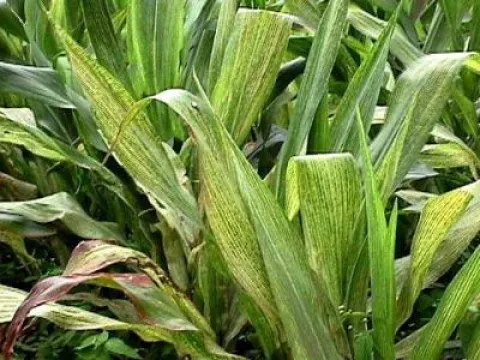
Maize streak virus
Mastrevirus storeyi
The causal agent of this disease is the Maize streak virus (MSV), a member of the genus Mastrevirus within the Geminiviridae family. It is characterized by a single-stranded circular DNA genome encapsulated in twin particles.
What the section contains
Maize streak virus
The virus has a wide host range including maize, sorghum, millet, and various wild grass species. It is not transmitted mechanically, through soil, or via seeds, which makes vector control the primary focus.
The disease is transmitted exclusively by leafhoppers of the genus Cicadulina, most notably Cicadulina mbila. The virus is persistent, meaning the leafhopper remains infectious for the remainder of its life after acquiring the virus.
Acquisition of the virus requires the leafhopper to feed on an infected plant for a specific duration. After an incubation period within the insect, it becomes capable of transmitting the virus to healthy plants.
At the cellular level, the virus interferes with chloroplast development, leading to the characteristic chlorosis observed on leaf surfaces. This systemic disruption affects the overall vitality and growth of the host plant.
The most diagnostic symptom is the appearance of narrow, pale chlorotic stripes that run parallel to the leaf veins. These stripes may be continuous or broken, eventually forming a mosaic-like pattern.
As the infection becomes systemic, new leaves emerging from the whorl display more pronounced striping. Older leaves may show less obvious signs, while younger foliage is severely affected.
Stunting and dwarfism are common consequences of early-stage infection. The internodes of infected plants are significantly shortened, giving the plant a stunted and distorted appearance.
The root system of infected plants is often poorly developed, which exacerbates the effects of environmental stress, particularly water deficiency. This contributes to the overall poor performance of the crop.
- Narrow chlorotic streaks along leaf veins.
- Mosaic appearance of the foliage.
- Significant stunting and reduced internode length.
- Poor ear development or total lack of grain formation.
- Reduced photosynthetic efficiency.
The prevalence of the disease is highly correlated with the population dynamics of its leafhopper vector. Warm, moderately humid weather conditions are optimal for the rapid multiplication of Cicadulina species.
High temperatures facilitate faster viral transmission by accelerating the metabolism of the vectors. Episodes of drought followed by rain can trigger population spikes, often resulting in widespread outbreaks.
The presence of wild grasses acting as reservoir hosts is a critical factor in the epidemiological cycle. These grasses maintain the virus in the environment throughout the year, serving as a primary source for new infections.
Planting dates significantly influence the risk of infection. Crops emerging during the peak migration periods of leafhoppers are at the highest risk of experiencing severe symptoms and yield losses.
Agricultural practices, such as excessive nitrogen fertilization, can promote succulent plant growth, making the crop more attractive to leafhoppers and potentially increasing the rate of viral transmission.
Maize streak virus is a devastating disease in many tropical and subtropical regions. Losses can reach up to 80% or even complete crop failure in highly susceptible hybrid varieties.
The economic impact is primarily driven by reduced grain filling and the development of empty or severely undersized cobs. The grain quality is often degraded, which directly affects marketability.
Plants infected at an early growth stage rarely recover and may fail to reach the reproductive phase. This results in uneven crop stands and the need for costly replanting efforts.
The viral infection suppresses the plant's natural defense mechanisms, making it susceptible to secondary infections by fungal or bacterial pathogens, further complicating the disease management.
Given the virus's ability to persist in natural reservoirs, the potential for annual recurrence remains high, requiring continuous vigilance and integrated management strategies.
The deployment of genetically resistant or tolerant maize hybrids is the most effective and sustainable management strategy. Resistant cultivars significantly mitigate the impact of the disease.
Effective weed management is essential to eliminate wild grass reservoirs. Removing these hosts from field edges and surrounding areas reduces the initial inoculum available to leafhopper populations.
Adjusting planting dates to avoid synchrony between the crop’s most vulnerable stages and the peak activity of leafhopper vectors can significantly reduce infection rates.
Chemical control of leafhoppers using insecticides can be implemented during the early stages of crop growth. However, this method is most effective when guided by regular scouting and monitoring of vector populations.
Early detection and prompt removal of infected plants can help reduce the viral spread in smaller fields. Integrated pest management (IPM) remains the best approach to control this persistent pathogen.