
Sida yellow mosaic
Begomovirus sidaflavachinaense
The disease is caused by the Sida yellow mosaic China virus (SiYMCV), a member of the Begomovirus genus within the Geminiviridae family. This virus possesses a single-stranded DNA genome and relies on specific insect vectors for transmission.
What the section contains
Sida yellow mosaic
The primary vector for the virus is the whitefly Bemisia tabaci. The insect acquires the virus while feeding on infected plant phloem and remains capable of transmitting the pathogen to healthy plants throughout its lifespan.
Once inside the plant, the virus systemically infects all tissues, disrupting hormonal balance and photosynthetic pathways. The virus utilizes the plant's machinery to replicate and spread throughout the vascular system.
The nature of begomoviruses makes them highly efficient at colonizing host plants. Their ability to evolve quickly poses a significant challenge for plant breeding programs focused on resistance.
Persistence of the virus within the host plant throughout the growing season ensures a continuous supply of inoculum for vectors to spread the disease to neighboring plants.
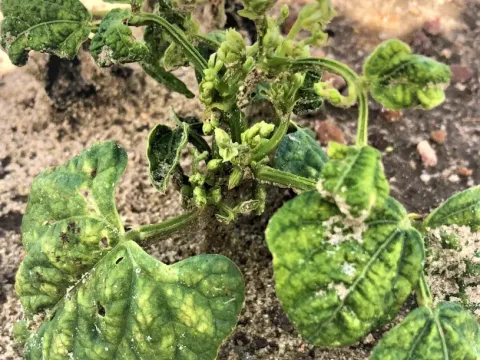
The hallmark symptom is a distinct chlorotic mosaic pattern on the leaves, characterized by patches of yellow and green discoloration. This mosaic often covers the entire leaf surface in severe cases.
Leaf deformation is a frequent secondary symptom. Infected leaves often become curled, crinkled, or reduced in size, which inhibits proper gas exchange and energy production within the plant.
Stunting is clearly visible in plants infected early in development. The internodes become shortened, and the overall plant growth is significantly inhibited compared to healthy specimens.
Flowering and fruit set are negatively impacted. Plants may show flower abortion or develop malformed fruits, leading to a substantial loss in total yield and quality.
In advanced stages, the combination of yellowing, curling, and stunted growth gives the plant an overall sickly appearance, eventually leading to reduced vigor and premature senescence.
The development of the disease is strictly linked to whitefly activity. Warm temperatures ranging from 25°C to 30°C provide the optimal conditions for rapid whitefly multiplication and virus transmission.
Weed hosts, particularly those in the Malvaceae family like Sida species, act as reservoirs for the virus. These plants harbor the pathogen during the off-season, serving as the starting point for epidemics.
Poor agricultural practices, such as high-density planting, facilitate the movement of whiteflies between plants. A high population of vectors combined with susceptible hosts leads to rapid disease spread.
The mobility of winged adult whiteflies allows for long-distance dispersal of the virus. This rapid movement often results in localized outbreaks that can quickly encompass entire farming plots.
Microclimate management in greenhouses is critical. High humidity and stable temperatures can accelerate both the pest lifecycle and the rate of viral infection if proper hygiene is not maintained.
The economic impact is primarily driven by yield reduction. Because the virus stunts plant growth and limits energy production, the harvest is usually significantly lower in quantity and quality.
Marketability is severely compromised due to leaf deformation and discoloration. Produce from infected plants often fails to meet quality standards for sale or human consumption.
Infected plants are immunocompromised, making them more susceptible to opportunistic secondary infections, including various bacterial and fungal pathogens that further weaken the plant.
In nurseries, the presence of the virus can result in the loss of entire batches of seedlings, representing significant financial losses and wasted resources in initial production stages.
Efforts to control the disease, including intensive pesticide application and crop destruction, add significant overhead costs to agricultural operations, reducing overall profit margins.
The primary control strategy involves managing the whitefly vector population. Systematic use of effective insecticides is required to keep vector numbers below the threshold for disease transmission.
Field sanitation is crucial. Removing weeds, particularly wild Malvaceae species, eliminates the primary reservoirs for both the virus and its insect vectors, breaking the disease cycle.
Using certified, virus-free planting material is essential to prevent the introduction of the pathogen into new areas. Spatial isolation between infected and healthy fields helps contain the outbreak.
Monitoring using yellow sticky traps allows farmers to detect the arrival of whiteflies early, enabling proactive intervention before the virus can be spread extensively.
- Regular inspection of crops for symptomatic leaves.
- Prompt roguing and destruction of infected plants.
- Implementation of crop rotation schedules.
- Use of fine-mesh netting in greenhouse environments to exclude whiteflies.