
Sida yellow mosaic virus
Begomovirus sidapallivariati
The causal agent of the disease is the Begomovirus sidapallivariati, which belongs to the genus Begomovirus within the Geminiviridae family. It is a plant virus featuring a single-stranded circular DNA genome.
What the section contains
Sida yellow mosaic virus
The disease is classified as a systemic viral infection, where the virus colonizes the plant's vascular system, disrupting its physiological functions. The viral particles are known for their characteristic geminate (twin-like) morphology.
Wild host plants from the Malvaceae family, such as Sida acuta, serve as primary natural reservoirs for the virus throughout the year.
The transmission is typically mediated by the whitefly Bemisia tabaci, which acts as a vector, acquiring the virus during feeding and spreading it to healthy host plants.
This virus employs a persistent transmission method, meaning the vector retains the ability to infect plants for a long duration after feeding on an infected source.
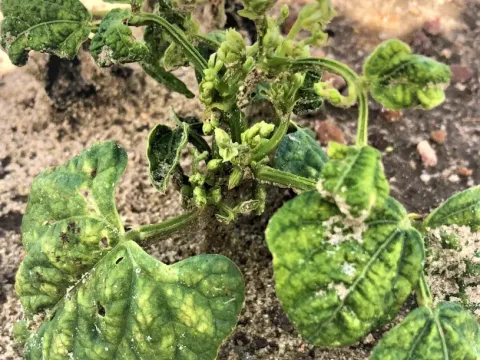
The initial signs of infection include the appearance of a distinct yellow mosaic pattern on the leaves, characterized by patches of yellow and green discolouration.
As the infection progresses, leaves may show severe chlorosis, accompanied by curling, distortion, and a reduction in the size of the leaf blades.
Infected plants exhibit stunted growth, which is primarily observed through shortened internodes and a marked reduction in total biomass development.
Severe symptoms include poor development of new shoots and a lack of vigor, indicating that the virus has significantly impacted the plant's metabolic capacity.
A notable diagnostic sign is the irregular distribution of chlorotic symptoms, which creates a highly variable appearance across the foliage compared to uniform nutrient deficiencies.
The spread of the virus is closely linked to the population dynamics of its primary vector, the whitefly, which thrives in warm and dry environmental conditions.
High whitefly densities in agricultural fields are the primary driver for rapid viral dissemination during the active growing season.
The presence of weeds, particularly Malvaceae species, near cultivated land allows the virus to survive between crop cycles and serves as a continuous source of inoculum.
Warm temperatures, generally above 25°C, significantly enhance both the reproduction rate of the vector and the replication cycle of the virus within the plant host.
Agricultural practices that promote high humidity within crop canopies can inadvertently create optimal microclimates for whitefly colonization and subsequent virus spread.
The economic harm caused by this virus is substantial, primarily due to the reduction in the plant's photosynthetic efficiency and overall energy production.
Early-season infection can lead to drastic yield losses, sometimes resulting in total crop failure if the infection is widespread and severe.
The virus impairs reproductive development, leading to fewer fruits, poor seed set, and lower overall quality of the harvested produce.
Infected crops show increased susceptibility to secondary fungal and bacterial pathogens, exacerbating the damage caused by the virus alone.
Management costs increase significantly due to the necessity for intensive vector control measures and labor-intensive plant removal programs.
The most effective strategy for managing the virus is the integrated control of the whitefly population through the use of systemic insecticides.
Cultural control practices, such as the systematic removal and destruction of host weeds like Sida species, are crucial for reducing primary inoculum sources.
Maintaining spatial isolation between susceptible crop fields and using high-quality, virus-free seeds or seedlings are recommended preventive measures.
In greenhouse or nursery environments, the use of fine-mesh insect screens is highly effective at physically excluding whiteflies from reaching the plants.
- Continuous field monitoring for the presence of adult whiteflies;
- Roguing of symptomatic plants to minimize viral spread;
- Implementation of crop rotation to break the pest's host cycle;
- Application of reflective mulches to deter vector landing.