
Sida yellow mosaic virus
Begomovirus sidaflavi
The causal agent is Sida yellow mosaic virus (SiYMV), a member of the Begomovirus genus within the Geminiviridae family. It is a single-stranded circular DNA virus known for targeting Malvaceae plant species.
What the section contains
Sida yellow mosaic virus
The infection is systemic and chronic. The viral genome consists of two DNA components that enable efficient replication and movement within the host vascular system, causing widespread physiological disruption.
The virus is characterized by its geminate (twinned) particle structure, which is a hallmark of the Geminiviridae family, protecting the DNA payload within host cells.
Natural reservoirs include various weed species, particularly those in the Sida genus, which act as perennial hosts allowing the virus to survive throughout the year.
Transmission occurs exclusively through the whitefly Bemisia tabaci. The virus is acquired through ingestion and is circulated within the insect's hemolymph, from where it is injected into healthy plant tissues.
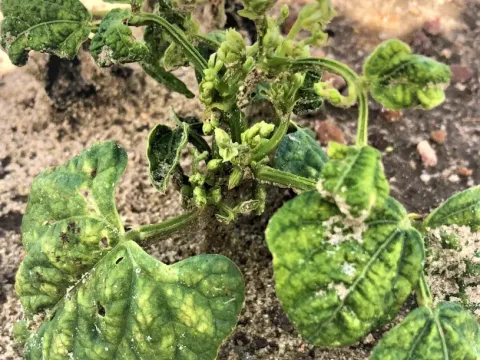
The primary symptom is a striking yellow mosaic pattern on leaves, often characterized by interveinal chlorosis that turns bright yellow as the infection advances.
Leaves exhibit significant structural changes, including curling, wrinkling, and overall deformation. This distortion significantly reduces the surface area available for photosynthesis.
Infected plants show severe stunting, with shortened internodes and restricted vegetative development. This lack of vigor makes the plant appear smaller compared to healthy specimens.
Reproductive growth is severely hampered. Affected plants often abort flowers or produce small, distorted fruits that fail to reach marketable size and quality.
As the disease progresses, chlorotic tissues may undergo necrosis, leading to early leaf senescence and drop, which drastically reduces the metabolic capacity of the crop.
The primary driver of spread is the population density of the whitefly vector Bemisia tabaci. High temperatures and moderate to high humidity are ideal for rapid whitefly multiplication.
The migration of whiteflies from weed-infested areas to crop fields is the critical trigger for seasonal epidemics. Fields located near wild Malvaceae populations are at high risk.
Continuous cropping systems in tropical and subtropical regions provide a constant supply of hosts, allowing the virus to persist and spread throughout the calendar year.
Climatic factors, such as warm winters, allow the whitefly populations to survive year-round, ensuring high initial viral pressure at the start of the next planting season.
Improper field hygiene, especially leaving fallow areas covered with host weeds, significantly increases the likelihood of viral transmission to nearby agricultural plots.
The virus causes substantial economic damage by reducing overall yield. Because the plant's metabolic pathways are damaged, it cannot fulfill its growth potential.
Fruit quality is severely impacted, with deformed and discolored products being rejected by markets, leading to significant revenue losses for producers.
Viral infection leaves the host plant susceptible to secondary attacks from pests and pathogens, as the plant's immune response is compromised by the viral load.
Management costs increase due to the frequent need for insecticide applications to control the whitefly population, which often erodes the profitability of the crop.
In severe cases, the entire crop may be lost if the infection occurs early in the growth stage, forcing farmers to abandon the area or replant, adding substantial costs.
Effective control focuses primarily on the whitefly vector. The use of systemic insecticides during early crop growth is essential to minimize initial infection rates.
Sanitation practices, specifically the removal of reservoir weeds (like Sida spp.) around fields and on fence lines, are crucial to reducing the viral inoculum source.
Implementing spatial isolation between fields and avoiding overlapping planting seasons can disrupt the whitefly migration patterns, significantly lowering disease pressure.
The development and deployment of resistant or tolerant crop varieties remain the most sustainable and efficient strategy for managing the virus long-term.
- Utilizing physical barriers like fine-mesh covers for seedlings.
- Deploying yellow sticky traps for monitoring and early detection of whiteflies.
- Rogueing and destroying symptomatic plants as soon as they appear.
- Optimizing planting dates to avoid high-activity periods of the whitefly.