
Passiflora severa begomovirus
Begomovirus passifloraseveri
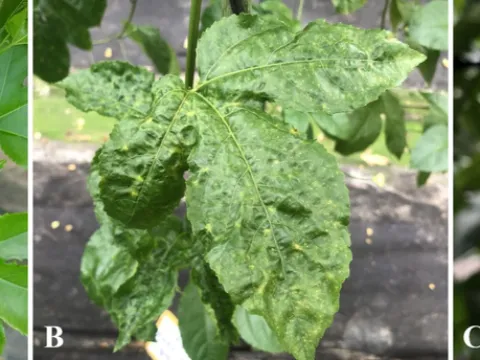
The primary symptom of infection is the development of distinct mosaic patterns on the leaves. Chlorotic areas appear, alternating with dark green patches, creating a variegated appearance.
What the section contains
Passiflora severa begomovirus
Leaf distortion is a common sign, with leaves often becoming wrinkled, crinkled, or asymmetrical. In severe cases, the margins may curl, significantly reducing the effective photosynthetic area of the plant.
Infected plants exhibit stunted growth, characterized by shortened internodes, which gives the vine a dwarfed or bushy appearance. Flowering is often reduced, and fruit set is frequently inhibited entirely.
Fruits that do develop are often misshapen, presenting spots or mottled patterns on the skin. These fruits lose their market value and sensory quality, making them unsuitable for commercial sale.
Diagnosis is challenging because symptoms can vary depending on the host variety and environmental conditions. Molecular diagnostic testing is typically required to confirm the presence of the virus.
The pathogen is a virus belonging to the genus Begomovirus within the family Geminiviridae. These are viruses with single-stranded circular DNA, primarily targeting tropical and subtropical plant species.
In the field, the virus is transmitted primarily by the whitefly Bemisia tabaci. The insect acquires the virus after feeding on the phloem of an infected host plant.
The virus exhibits persistent transmission, meaning the insect remains infectious for a significant portion of its life after the acquisition period, which can be as short as a few minutes.
Mechanical transmission is also possible during horticultural practices such as pruning, grafting, or taking cuttings. However, the vector-based route remains the most common method of spread.
The virus is adapted to replicate within the phloem tissues. This localization facilitates rapid systemic movement throughout the plant's vascular system, leading to widespread infection shortly after inoculation.
Viral development is highly dependent on whitefly population dynamics. Optimal conditions for transmission include high humidity and temperatures ranging from 25 to 30 degrees Celsius.
In greenhouse settings, outbreaks occur more frequently due to the confined space, which allows for rapid migration of insect vectors between plants.
Failure to manage weeds around the growing area creates reservoirs for the virus. Many weed species serve as asymptomatic hosts, maintaining the viral presence between cropping cycles.
Plant stress, such as temperature fluctuations or improper irrigation, weakens the plant's natural defenses, allowing the virus to replicate more aggressively and trigger more severe symptoms.
The use of contaminated tools is a major risk factor in large collections. A single infected vine can serve as an inoculum source for the entire crop if sanitization protocols are ignored.
The damage caused by the begomovirus stems from its systemic impact on plant physiology. Stunting and vascular blockage lead to severe depletion of the root system and plant decline.
Economic losses are severe, primarily due to the total loss of marketable fruit. Reduced sugar content and physical deformities render the produce useless for commercial distribution.
The virus significantly reduces the lifespan of the host. Infected plants often die within one or two seasons, forcing growers to remove and replace entire sections of the crop.
Rapid spread of the virus requires drastic measures, such as the rogueing and destruction of symptomatic plants. This results in significant direct costs due to the loss of established vegetation.
Given the lack of effective curative treatments for viral diseases, Begomovirus passifloraseveri represents a major threat to the global passion fruit industry.
The primary control strategy is the exclusion of whiteflies from greenhouse structures. This involves using fine-mesh insect-proof netting on all vents and entryways.
Regular monitoring using yellow sticky traps is essential to detect whitefly presence. Upon detection, immediate insecticide treatment is necessary to minimize the risk of viral spread.
Strict phytosanitary practices must be followed, including the sterilization of pruning tools between every plant using disinfectants like sodium hypochlorite or alcohol-based solutions.
Growers should source only virus-free certified plant material. Cuttings should never be taken from plants showing any signs of chlorosis, leaf curl, or stunted growth.
- Implement a strict weed management program around the greenhouse.
- Early rogueing and incineration of symptomatic plants.
- Use of biological control agents for whitefly populations.
- Optimizing greenhouse microclimate to reduce plant stress.