
Passiflora latent virus
Carlavirus latenspassiflorae
Passiflora latent virus (PLV) is a member of the genus Carlavirus within the Betaflexiviridae family. It is a single-stranded RNA virus that is notorious for its ability to persist in plant tissues without causing obvious disease symptoms.
What the section contains
Passiflora latent virus
The virus is primarily transmitted mechanically through tissue damage. This occurs during standard horticultural practices such as pruning, grafting, or taking cuttings, especially when tools are not properly sanitized between plants.
The host range is relatively specific to members of the Passifloraceae family. Once infected, the virus establishes a systemic infection, spreading through the vascular system to reach all organs of the plant.
Biologically, the virus is highly adapted to its host, utilizing cellular machinery for its replication while maintaining a stable, low-profile concentration. This latency allows the virus to be propagated through cuttings unknowingly, leading to widespread distribution in nurseries.
Detection relies on molecular techniques such as ELISA (Enzyme-Linked Immunosorbent Assay) or RT-PCR, as the virus does not produce distinct visual symptoms that could allow for easy field identification.
The most defining characteristic of this pathogen is its latency. In many cultivars, infected plants appear completely asymptomatic, maintaining normal growth patterns and leaf appearance under standard conditions.
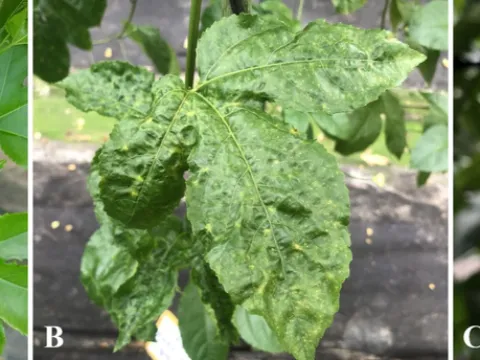
In highly susceptible varieties, the virus may induce mild chlorosis, slight mottling, or faint mosaic patterns on the foliage. These signs are inconsistent and often emerge only under environmental stress, such as heat or nutrient deficiency.
Minor growth reduction or delayed development of new shoots might occur. However, these symptoms are often subtle and can easily be attributed to poor soil quality, pest activity, or unfavorable irrigation regimes.
When symptoms appear, they typically manifest as subtle discoloration during rapid leaf expansion. Growers should look for inconsistent leaf color variations compared to healthy specimens of the same age and cultivar.
Because the plant remains a long-term carrier, the lack of symptoms is deceptive. The virus remains active in the plant’s sap, providing a constant reservoir for further transmission to other plants in the plantation.
The spread of Passiflora latent virus is closely linked to agricultural hygiene practices. The use of shared cutting tools without adequate disinfection is the primary driver of transmission within greenhouses and fields.
Environmental conditions that favor active plant growth also favor the maintenance and potential spread of the virus. High-density planting increases the frequency of plant-to-plant contact, which can facilitate transmission if tissues are damaged.
The use of infected planting material is the most significant risk factor. Since the virus is often asymptomatic in stock plants, nurseries may inadvertently propagate and distribute infected cuttings to new growers.
Nearby weeds or reservoirs of infection can play a role in the epidemiological cycle. Although the virus is mainly mechanical, monitoring the surroundings for plants showing viral-like symptoms is a standard biosecurity procedure.
Temperature and humidity stability in commercial greenhouses ensure that infected plants remain robust enough to keep the viral population high, which is essential for the persistence of the pathogen in a controlled environment.
The primary harm caused by Passiflora latent virus is a steady, cumulative decline in crop productivity. Even without visible disease, the viral presence drains the plant's metabolic resources, leading to long-term yield reduction.
Infected plants exhibit lower resistance to secondary pathogens. Weakened immunity makes the crops more vulnerable to opportunistic fungal infections, which are often the direct cause of plant death in virus-infected plots.
Fruit quality may be compromised, with potential reductions in sugar content, size, and shelf life, which are critical parameters for the commercial success of passion fruit production.
On a cellular level, the virus interferes with photosynthesis and carbohydrate storage. This impairment affects the overall development and vigor of the plant, potentially leading to shortened lifespan and increased susceptibility to environmental extremes.
Economic damage is substantial, as a high prevalence of the virus forces growers to perform expensive large-scale removal and replacement of planting material to maintain profitability.
Prevention is the only viable management strategy. Growers should strictly source planting material from certified, virus-tested, and disease-free nursery stocks.
- Strict sanitation protocols for all pruning and grafting tools using bleach or alcohol solutions.
- Regular inspection and laboratory testing of mother plants to identify and remove infected individuals.
- Proper disposal of all symptomatic or suspected plant material to reduce the reservoir of the virus.
- Minimizing plant handling during conditions that facilitate mechanical transmission, such as when foliage is wet.
- Implementing integrated crop management to ensure optimal nutrient and water status, enhancing plant vigor.
There are no chemical treatments available to eradicate the virus from an infected plant once it has become systemic. Therefore, hygiene and rigorous selection remain the cornerstones of disease control.
Future management relies on breeding or selecting for virus resistance or tolerance. In the meantime, strict adherence to exclusion and sanitization measures is the most effective approach to minimize impact.