
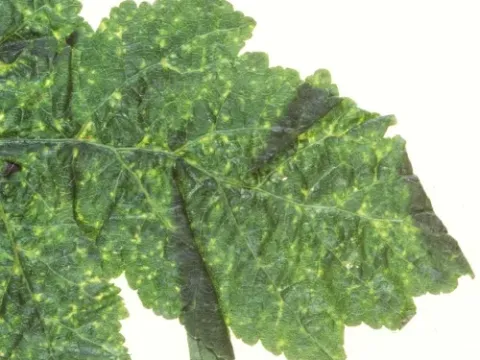
Parsnip yellow fleck virus
Sequivirus pastinacae
The primary symptom of the infection is a distinct yellowing, typically concentrated on young leaves and the center of the plant's rosette.
What the section contains
Parsnip yellow fleck virus
Leaves may exhibit severe curling, deformation, and chlorotic patches, which significantly diminish the plant's photosynthetic capacity.
Infected plants show stunted growth, resulting in small, underdeveloped, and poor-quality taproots that are unsuitable for commercial sale.
Premature senescence and death of older leaves are common as the plant struggles to compensate for the loss of vitality in the central leaves.
Disease expression is highly dependent on the plant's age at the time of infection and the specific environmental conditions during the growing season.
The disease is caused by the Parsnip yellow fleck virus (PYFV), which belongs to the Sequivirus genus of plant viruses.
The virus is transmitted by aphids in a semi-persistent manner, meaning the insect remains infectious for a period after feeding on an infected plant.
A unique feature of this virus is its reliance on "helper" viruses, such as the Anthriscus yellows virus, to facilitate successful transmission and infection.
It predominantly affects crops within the Apiaceae family, including parsnips, carrots, and parsley, as well as various wild umbelliferous weeds.
The viral particles are small and spherical, containing single-stranded RNA, which makes them highly efficient at utilizing insect vectors for dispersal.
The spread of the virus is closely tied to the migration patterns of aphid vectors, which actively move the virus through the fields.
Warm and dry weather conditions provide the perfect environment for aphid reproduction, leading to rapid disease outbreaks during the summer months.
Wild Apiaceae plants growing near cultivated fields act as crucial reservoirs for the virus, allowing it to survive and jump to new crops.
Poor field management, including heavy weed infestation and high-density planting, creates favorable conditions for vector colonization.
Early-season infections are particularly devastating, as they have the longest duration to impair the plant's growth and development throughout the cycle.
Parsnip yellow fleck virus causes significant economic losses by drastically reducing the yield and quality of marketable parsnip taproots.
Plants weakened by the virus are more susceptible to secondary infections, often resulting in root rot during post-harvest storage.
Reduced photosynthesis leads to a decrease in sugar and flavor compounds, negatively impacting the crop's nutritional and market value.
In severe cases, the entire harvest may become unmarketable due to the stunted size and unsightly deformation of the roots caused by the virus.
Since there are no curative measures for infected plants, the damage caused by the virus persists throughout the entire growing season.
Effective management focuses on aphid control using strategic insecticide applications to prevent the virus from spreading throughout the field.
Sanitation is critical; removing all wild host plants from field margins helps eliminate the primary reservoirs of the viral pathogen.
Maintaining proper spatial isolation between plantings can significantly decrease the risk of aphid-mediated transmission between different crop batches.
Cultural practices that promote vigorous plant growth help the parsnip withstand infection pressure better than stressed or malnourished crops.
- Strict aphid population monitoring and management.
- Removal of wild host weeds from the field perimeter.
- Spatial isolation between sequential plantings.
- Use of virus-free or tolerant varieties where available.