
Helminthosporium leaf spot of oats
Pyrenophora victoria
The disease is caused by the fungus Pyrenophora victoriae (anamorph Bipolaris victoriae), a serious pathogen affecting oat crops worldwide.
What the section contains
Helminthosporium leaf spot of oats
The fungus survives in crop residues, soil, and on the surface or inside the endosperm of the seeds, serving as primary inoculum for future seasons.
Under favorable spring conditions, the fungus produces conidia which are disseminated by wind, rain splashes, or contaminated machinery across the field.
The pathogen secretes a potent host-specific toxin known as victorin, which facilitates rapid infection and host tissue colonization.
Its ability to infect both roots and foliage makes it a versatile pathogen capable of causing systemic damage to the oat plant throughout its lifecycle.
Initial infection often presents as dark, reddish-brown streaks on seedlings, which frequently lead to damping-off and the death of young plants.
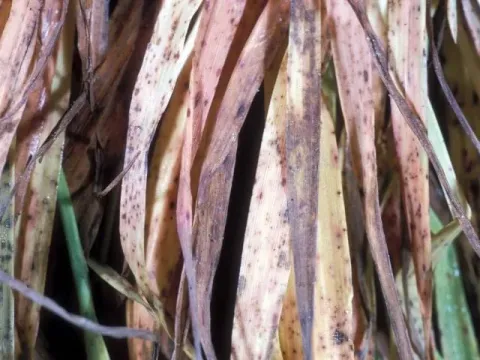
On mature leaves, symptoms appear as elongated or oval brown spots often surrounded by a chlorotic or yellow halo, which may coalesce as the disease progresses.
Dark velvety mold, consisting of conidiophores and conidia, can be observed on the basal stems and nodes during periods of high humidity.
The crown and root system often show signs of necrosis, leading to plant lodging and overall physiological decline of the crop.
Infected panicles are often poorly filled, resulting in shriveled or underdeveloped grains that significantly reduce the quality of the harvested produce.
The development of the disease is favored by mild temperatures, typically between 18 and 24 degrees Celsius, combined with high humidity.
Prolonged wet weather patterns during the tillering and jointing stages are crucial for the mass production and spread of fungal spores.
Poor soil drainage and high moisture levels in the root zone facilitate the infection process and increase the severity of root and stem rot.
Continuous cropping of oats without rotation creates a high buildup of the pathogen in the soil, leading to an increased likelihood of early infection.
Warm, humid nights followed by foggy mornings provide ideal conditions for the fungus to sporulate on infected plant parts and spread to healthy leaves.
Helminthosporium leaf spot causes significant yield losses by reducing plant density through seedling blight and early plant mortality.
Reduction in the leaf area available for photosynthesis leads to lower biomass accumulation and weaker plants susceptible to secondary infections.
The disease causes brittleness in stems, leading to severe lodging which makes mechanical harvesting difficult and increases pre-harvest grain loss.
The quality of the grain is heavily impacted, showing lower bushel weight, reduced protein content, and poor germination rates for future seeding.
In severe infestation years, losses in grain yield can range significantly, often reaching up to 50 percent in susceptible varieties under ideal conditions.
The primary control measure is the use of high-quality, treated seed, as seed-borne inoculum is a major factor in the disease cycle.
Implementing a rigorous crop rotation plan that excludes oats for several years helps in breaking the pathogen's survival cycle.
Deep plowing or incorporating crop residues into the soil helps accelerate the decomposition of infected matter, reducing the source of primary inoculum.
Foliar application of authorized fungicides at the early signs of leaf spot infection is essential to prevent rapid spread during the growing season.
- Utilizing disease-resistant or tolerant oat cultivars suited to local climates.
- Ensuring balanced fertilization to promote plant vigor and resilience against pathogen attack.
- Managing irrigation to avoid prolonged leaf wetness in the canopy.