
Thistle rust
Puccinia cirsii
Description
Symptoms
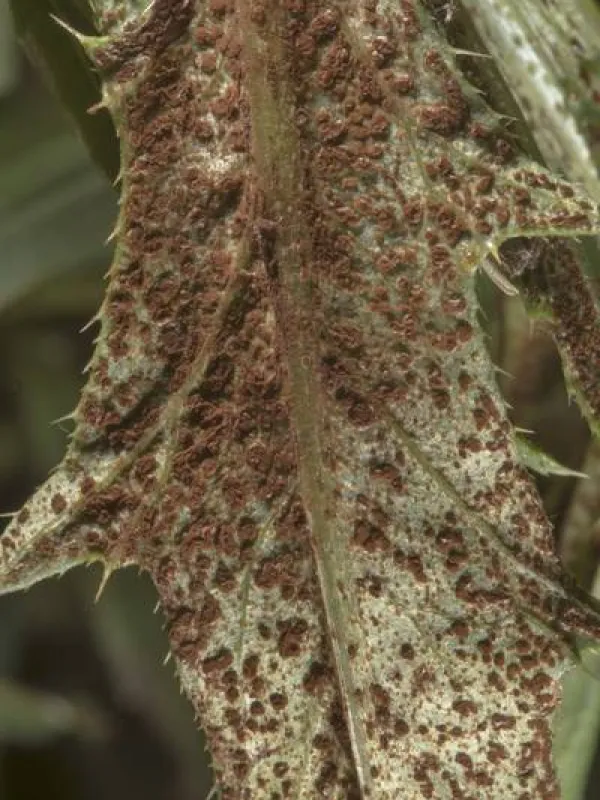
Initial symptoms include small yellow to orange spots appearing on the leaf surface. As the infection progresses, these spots evolve into pustules that rupture the plant epidermis.
When the pustules mature, they release a fine powder of rust-colored spores. In cases of severe infection, the foliage may become entirely covered with this powdery substance, leading to chlorosis and tissue necrosis.
Infected stems often exhibit visible deformations, such as swellings, twisting, or stunted growth. This physical damage significantly interferes with the translocation of nutrients and water throughout the plant.
As the growing season concludes, the color of the pustules typically darkens to a deep brown or black, signaling the production of overwintering spores.
- Appearance of bright orange/yellow spots
- Formation of powdery rust pustules
- Stem deformation and twisting
- Early leaf senescence and chlorosis
Pathogen
The causative agent of this disease is a specialized basidiomycete fungus known as Puccinia cirsii, which belongs to the order Pucciniales. It is an obligate parasite, meaning it requires living host tissue to complete its lifecycle.
The fungus is highly specific to the genus Cirsium (thistles). Its complex lifecycle involves the production of different spore types, including urediniospores and teliospores, which facilitate rapid spread and survival.
The mycelium develops within the intercellular spaces of the host leaves and stems, absorbing nutrients and disrupting the plant's normal physiological functions such as gas exchange and photosynthesis.
Survival through adverse conditions, including winter, is achieved either via mycelium embedded in the perennial roots of the thistle or through durable teliospores on debris.
Due to its high virulence and host specificity, this fungus acts as a significant natural regulator of thistle populations in diverse ecological environments.
Conditions for development
The development of thistle rust is highly favored by high atmospheric humidity and moderate temperatures, typically ranging between 15 and 22 degrees Celsius.
Moisture, provided by dew, frequent rainfall, or persistent fog, is essential for the germination of fungal spores on the plant surface. Dense stands of thistles create microclimates that retain humidity, promoting rapid infection.
Wind is the primary vector for the dispersal of spores over short and long distances, allowing the disease to spread throughout fields and across geographical regions efficiently.
While the pathogen requires a living host, environmental stress on the thistle can sometimes make the host more susceptible to the fungal invasion by lowering its natural defenses.
The disease cycle can repeat multiple times throughout the summer months as long as the host plant is actively growing and conditions remain humid.
Why it matters
In an agricultural context, thistle rust is often viewed as a beneficial biocontrol agent rather than a harmful disease, as it actively suppresses the growth of competitive thistle weeds.
The infection significantly reduces the vigor of the thistle, depleting the energy reserves stored in the roots and diminishing the plant's capacity for vegetative regeneration in subsequent years.
Plants affected by the fungus show decreased reproductive potential, forming fewer flower heads and producing a lower volume of viable seeds to infest nearby croplands.
By weakening the thistle's structure and reducing its size, the fungus decreases the weed's ability to compete with cultivated crops for light, water, and nutrients.
While potentially damaging to the thistle, it poses little to no threat to commercial crop species, making it an ecologically friendly tool for natural weed management.
Protection
Specific chemical control is rarely required for thistle rust, given its role as a natural weed suppressor. Management efforts usually focus on the host plant itself rather than the pathogen.
Agricultural practices such as deep tillage or mechanical weed removal effectively reduce thistle populations, thereby decreasing the overall host availability for the fungus.
Maintaining crop rotation and good field hygiene helps manage weed infestation levels, which in turn limits the spread of the pathogen if it is undesirable in specific areas.
Fungicide application is not recommended, as it would be economically unjustified and would counter the benefit of having a natural biological control agent working against the thistle.
The primary control strategy involves promoting overall soil health and crop competition, which naturally keeps thistle populations below an economic injury threshold.
Discussion
No discussions yet — be the first.