
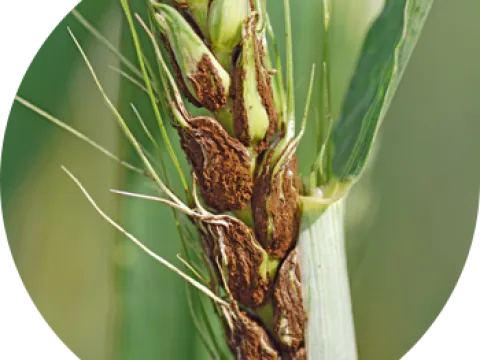
Smut fungi
Ustilaginomycetes
Smut diseases are caused by basidiomycete fungi belonging to the class Ustilaginomycetes. These specialized parasites primarily infect cereal crops, including wheat, barley, oats, and corn.
What the section contains
Smut fungi
The fungal mycelium invades the host plant tissue during the early stages of development or at the flowering stage. As the pathogen grows within the stems or inflorescences, it gradually replaces healthy plant tissues with its own spore mass.
The fungus completes its life cycle by producing vast quantities of teliospores. It is these spores that give affected plant organs their characteristic charred or sooty appearance, which is the hallmark of the disease.
Depending on the species, the infection can be seed-borne, soil-borne, or air-borne during the flowering phase. The biological specialization of these fungi makes them highly targeted threats to specific cereal types.
Depending on the transmission method, pathogens may persist on the surface of seeds, inside the grain, or as dormant mycelium in the soil, which dictates the specific protective measures required.
The primary symptom is the transformation of plant parts into a black, powdery mass of teliospores. Affected ears or panicles appear as charred structures, which is often visible even before the harvest period.
With loose smut, the entire ear is destroyed and converted into a loose mass of spores that disperses easily in the wind. By the time of maturity, often only a bare rachis remains.
Covered or stinking smut presents differently: the infected grain retains its shape but is filled with black spores covered by a thin membrane. These "smut balls" are often discovered only during the threshing process.
Infected plants may exhibit stunting, stem twisting, or excessive tillering. The appearance of the fields becomes uneven, which is noticeable during visual field inspection.
Leaves and stems can also be covered in specific pustules where spores mature, disrupting photosynthesis and weakening the overall development of the plant.
Disease development is closely linked to weather conditions during seed germination and crop flowering. High soil moisture and moderate temperatures favor the infection of young seedlings.
For infections transmitted via air during flowering, rainy and overcast weather is the decisive factor. Moisture facilitates the germination of spores on the stigma of healthy ears.
Soil temperature plays a key role: for many smut species, temperatures between 10–20 degrees Celsius are optimal. Deviations from these ranges can slow down the infection process.
Agricultural practices, including sowing depth and seed density, affect pathogen intensity. Planting too deeply delays emergence, increasing the time the seedling is exposed to infection.
The presence of viable spores in the soil or on seeds creates high inoculum pressure, where even minor climatic fluctuations can lead to widespread epidemics.
The main damage is the reduction in grain yield, as infected ears often produce no grain or form shriveled, low-quality seeds that are unfit for commercial use.
The presence of smut spores in the harvested grain reduces its market value and makes it unsuitable for food purposes due to an unpleasant odor and potential fungal toxins.
Infected crops require additional costs for cleaning and separation of the grain mass. Using such harvests for animal feed without special treatment is often prohibited due to toxicity risks.
The accumulation of inoculum in the soil and on seed material necessitates the annual use of expensive crop protection products, increasing production costs.
Economic losses include not only direct yield reduction but also indirect expenses related to managing the spread of the pathogen in subsequent seasons.
Seed treatment with systemic fungicides before sowing is the foundation of smut control. This is the most effective method to eliminate both surface and internal infections.
Strict adherence to crop rotation helps reduce the accumulation of the pathogen in the soil. Replanting susceptible crops on the same field should be avoided for at least 2–3 years.
The use of certified, disease-resistant crop varieties is the most environmentally friendly and economically sound management strategy.
Proper soil tillage, including the timely incorporation of crop residues and adherence to optimal sowing dates, helps plants overcome the vulnerable growth phase quickly.
- Application of fungicides during the flowering period for specific smut types.
- Ensuring optimal sowing depth and seedbed conditions.
- Using only certified, spore-free seed material.