
Snapdragon downy mildew
Peronospora antirrhini
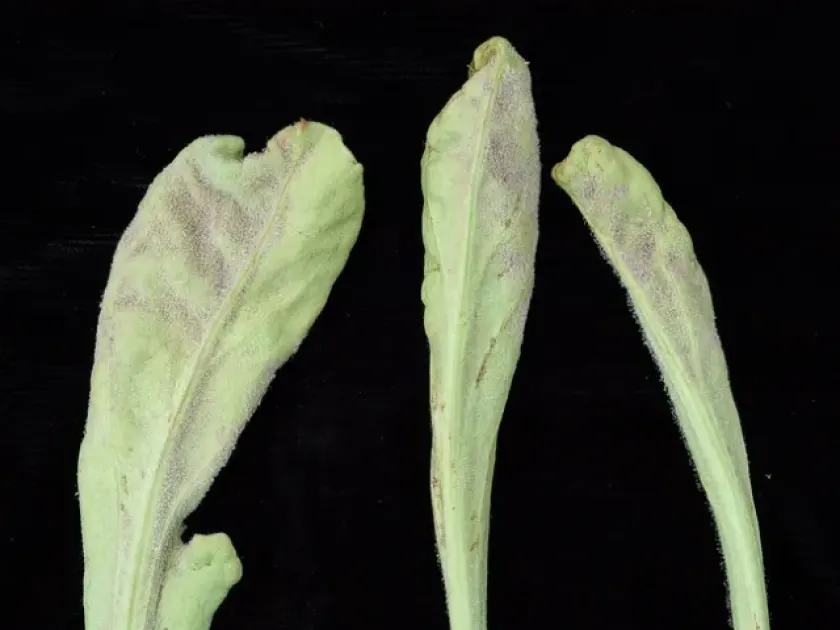
Description
Symptoms
The first symptoms of infection appear as chlorotic spots on the upper side of the leaf blade, which eventually turn yellowish or brown.
On the underside of the leaf, in the affected areas, a characteristic grayish-violet or gray-white fuzz appears, representing the pathogen's sporulation. In high humidity, this growth becomes particularly dense.
The leaves of the affected plants gradually deform, curl, and begin to drop prematurely. The growth of shoots is noticeably slowed, leading to stem twisting.
In severe cases, the plant completely loses its ornamental value, and apical buds may die off. Adult plants look stunted, with systemic infection observed in all aerial parts.
The root system often remains visually healthy; however, due to the death of the photosynthetic apparatus, the plant stops flowering and gradually withers.
Pathogen
The causative agent of the disease is the oomycete Peronospora antirrhini, which belongs to the group of downy mildew fungi. It is a highly specialized pathogen that affects exclusively plants of the Antirrhinum genus.
The microorganism spreads via zoospores that actively move in water droplets. Within the plant tissues, the pathogen forms a mycelium that penetrates intercellular spaces, leading to the rapid depletion of the crop's nutrients.
The infection persists in plant debris, in the soil, and can also be transmitted through contaminated seed material. The viability of the fungus oospores in the soil can persist for several years.
The life cycle of the pathogen is closely tied to environmental humidity. Under favorable conditions, the fungus is capable of producing several generations of spores within a single growing season, causing epiphytotics in greenhouses.
For laboratory diagnosis of the pathogen, microscopy is used, which allows for the detection of specific conidiophores emerging through the leaf stomata.
Conditions for development
The optimal conditions for disease development are high humidity (above 85%) and moderate temperatures ranging from 15 to 20 degrees Celsius.
Crowded plantings, where natural air circulation is obstructed, create an ideal microclimate for the germination of Peronospora antirrhini zoospores.
Nighttime temperature drops accompanied by dew formation trigger massive spore production, leading to the rapid spread of the disease in a garden or greenhouse.
In closed ground, the risk of downy mildew development increases with poor ventilation and overhead irrigation, where water droplets land directly on the leaves.
Prolonged periods of cloudy weather also contribute to the retention of moisture on plant surfaces, facilitating the pathogen's entry into the snapdragon tissues.
Why it matters
Downy mildew is one of the most dangerous diseases for snapdragons, capable of completely destroying a collection of plants in a short period.
The disease leads to a sharp decline in the quality of marketable produce in commercial flower cultivation for cut flowers.
Infection during the early stages of seedling development leads to massive seedling loss, resulting in significant economic losses.
Plants that survive the fungal attack are severely weakened, lose immunity to other secondary infections, and produce virtually no high-quality seeds.
The spread of the pathogen in the soil makes it impossible to grow snapdragons on the same site for several subsequent years without proper soil disinfection.
Protection
The primary control measure is strict adherence to agronomic practices: avoiding crowded plantings, ensuring good ventilation, and watering only at the base, avoiding leaf wetting.
It is essential to promptly remove and destroy affected plants to prevent the spread of spores to healthy specimens.
Preventive spraying with copper-based fungicides or modern systemic products (like metalaxyl or mancozeb) helps to suppress disease development in early stages.
As a preventive measure, soil disinfection before sowing and the use of resistant varieties, if such breeding forms are available, are highly recommended.
Crop rotation should be practiced; returning snapdragons to the same planting spot is not recommended for at least 3-4 years after the last infection outbreak.
Discussion
No discussions yet — be the first.