
Snapdragon rust
Puccinia antirrhini
Description
Symptoms
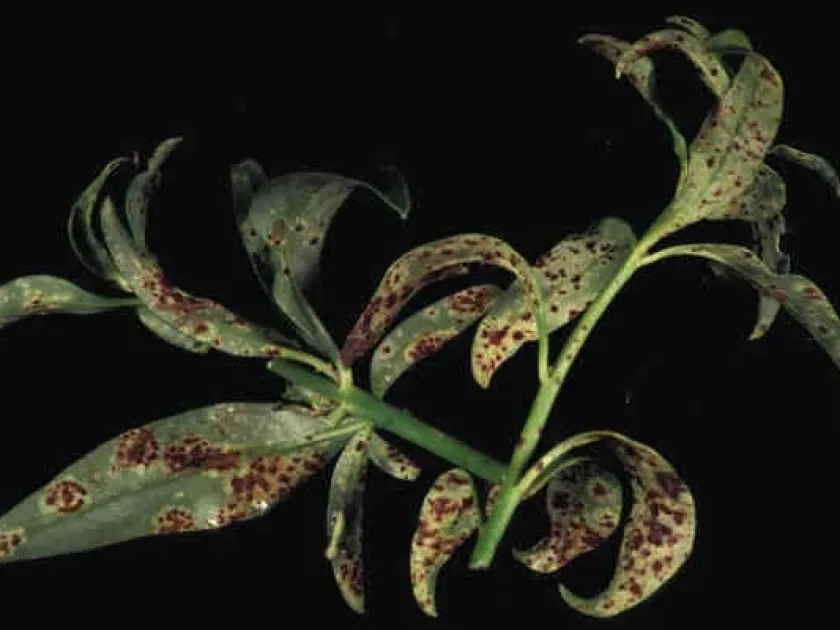
Initial symptoms appear as small pale yellow spots on the undersides of leaves and stems. Soon after, these areas develop pustules — circular bumps of brown or dark reddish-brown color.
As the disease progresses, these pustules become more numerous and eventually coalesce. Leaves turn yellow, curl up, and fall prematurely, significantly suppressing plant vitality.
On stems, pustules are often elongated, which causes stem deformation and disrupts nutrient flow. The plant loses its aesthetic value and stops producing flowers.
In severe cases, affected stem segments become brittle, and the tissues surrounding the pustules may become necrotic, forming dry, dark lesions.
Visual diagnosis is easily performed by observing the characteristic "rusty" powder that rubs off when touched, which is actually a dense collection of fungal spores.
Pathogen
The causative agent of this disease is the specialized basidiomycete fungus Puccinia antirrhini. This is an obligate parasite that infects exclusively plants within the Antirrhinum genus.
The fungus's life cycle involves the formation of urediniospores, which facilitate rapid infection spread throughout the growing season. Spores are dispersed by wind, rain splashes, or contaminated gardening tools.
The fungus overwinters on plant debris in the soil, as well as on perennial varieties. In greenhouse conditions, the infection can persist year-round, cycling from one plant to another.
The pathogen exhibits high specialization; it invades plant tissues through stomata, after which the mycelium spreads within the intercellular spaces, absorbing host nutrients.
Intense sporulation forms characteristic pustules that rupture the plant epidermis, leading to tissue damage and the dissemination of spores across the plot.
Conditions for development
Disease development is favored by high humidity (above 70–80%) and moderate temperatures between 15°C and 22°C, which are ideal for spore germination.
Densely planted snapdragons with poor air circulation create a microclimate that promotes rapid infection spread between plants.
Overhead irrigation is one of the primary risk factors, as leaf surface moisture is essential for fungal spores to germinate and infect the tissue.
Prolonged morning dew or fog significantly accelerates infection even in the absence of rain. In greenhouses, the disease spreads rapidly due to poor ventilation.
Improper fertilization, particularly excessive nitrogen, makes plant tissues succulent and softer, facilitating easier fungal penetration.
Why it matters
Snapdragon rust is an extremely destructive disease capable of completely ruining a planting within a few weeks if left unmanaged.
Severe infection halts photosynthesis due to mass leaf drop, which effectively stops growth and prevents flower spike formation.
In commercial floriculture, the product becomes unmarketable; plants lose their symmetry, buds fail to open or drop off, causing significant economic losses.
Pathogen-weakened plants become highly susceptible to secondary infections and pest attacks, further exhausting the plant's life resources.
During epiphytotic development, spores can be carried over long distances by wind, infecting healthy sites located hundreds of meters away from the infection source.
Protection
The foundation of control is prevention: using only healthy propagation material and removing all infected plant parts immediately upon detecting the first pustules.
It is essential to maintain proper spacing between plants to ensure good airflow. Always use drip irrigation to avoid getting water on the leaves.
- Deep autumn soil cultivation and thorough removal of all plant debris.
- Crop rotation, avoiding planting snapdragons in the same spot for at least 3-4 years.
- Selection of cultivars known for higher resistance to fungal pathogens.
Upon initial symptoms, apply fungicides containing copper, sulfur, or systemic chemicals from the triazole and strobilurin classes.
Regular preventive fungicide applications during the growing season, especially in humid or cool weather, are crucial for keeping the pathogen in check.
Discussion
No discussions yet — be the first.