
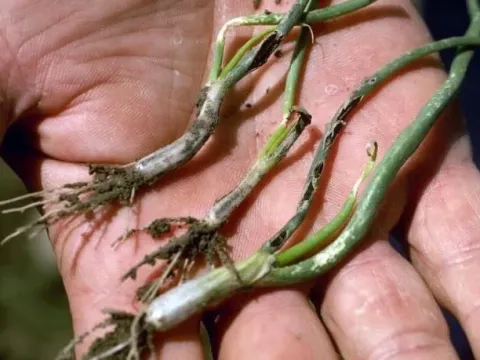
Flag smuts
Urocystidales
The causal agents of flag smut diseases belong to the order Urocystidales, which consists of obligate parasitic basidiomycetes.
What the section contains
Flag smuts
These fungi produce teliospores typically arranged in spore balls, which are encased by specialized sterile cells to enhance survival in the environment.
The infection process is systemic, starting at the seedling stage when the germinating teliospore penetrates the host tissue, leading to colonization of the entire plant.
Key species include Urocystis occulta (rye flag smut) and Urocystis cepulae (onion smut), which are economically significant pathogens.
The biology of these fungi is characterized by long-term survival in soil and seed, often necessitating integrated management approaches to mitigate spread.
Symptoms are manifested as linear blisters or pustules that develop along the veins of leaves and stems, initially covered by the host epidermis.
As the disease progresses, the epidermis ruptures, releasing a characteristic black, powdery mass of spores that gives the plant a scorched appearance.
Infected plants frequently exhibit severe stunting, leaf curling, and twisted growth, making them easily distinguishable from healthy individuals.
In the case of onion smut, grey-black streaks appear on the scales of bulbs and leaves, leading to the distortion of young seedlings.
Plants affected by these pathogens often fail to produce viable heads or ears, resulting in direct yield loss and reduced marketability of the crop.
The development of flag smuts is heavily dependent on soil temperature during the germination phase of the host plant.
Cooler soil temperatures, generally between 10°C and 18°C, are optimal for the infection of seedlings, often aligning with early planting windows.
Sufficient soil moisture is required for the germination of teliospores, creating an environment that facilitates successful host invasion.
The ability of the spores to remain viable in the soil for several years poses a constant threat to subsequent crops planted in infested fields.
Climatic factors and agricultural practices that favor slow seedling emergence extend the exposure time to the pathogen, increasing infection rates.
The primary harm caused by these pathogens is the reduction of plant vigor and systemic interference with plant growth, leading to yield loss.
Crop stands become thin and uneven due to the death of infected seedlings, which decreases the overall productivity of the cultivated area.
Infestation reduces the quality of harvested produce, rendering it unsuitable for long-term storage or processing due to potential secondary infections.
The accumulation of spores in the soil leads to long-term economic damage, limiting the choice of crops in future rotations.
Economic losses are compounded by the need for costly fungicides and the potential for regulatory restrictions on the sale of infected seed material.
The use of certified, disease-free seed is the most effective primary measure for preventing the introduction of flag smuts into new areas.
Crop rotation with non-host species for several years is essential to deplete the soil spore bank and break the pathogen's life cycle.
Seed treatment with systemic fungicides provides critical protection during the early stages of seedling development, significantly lowering infection levels.
Selecting and planting resistant or tolerant cultivars is a sustainable strategy that reduces reliance on chemical inputs and ensures consistent yield.
- Treating seeds with appropriate systemic fungicides.
- Implementing long-term crop rotation schemes.
- Deep plowing to bury infested crop debris.
- Monitoring fields for early symptoms and removing infected plants.