
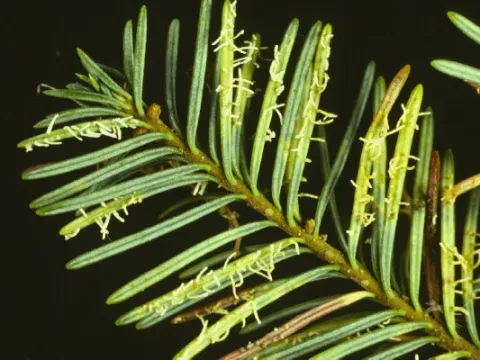
Uredinopsis
Uredinopsis
The causative agent of the disease is a fungal pathogen from the genus Uredinopsis, belonging to the rust fungi family (Pucciniales order). It is a specialized obligate parasite.
What the section contains
Uredinopsis
The biological cycle of the fungus is complex and often involves a heteroecious life cycle, alternating between fern hosts and conifer species like fir trees.
The pathogen utilizes haustoria to penetrate the plant tissue and absorb nutrients, which directly leads to cellular degradation and tissue chlorosis.
The production of urediniospores occurs on the undersides of leaves, allowing the fungus to disseminate efficiently across the host population via wind and rain splash.
Survival through winter is achieved by the formation of resting spores or persistence as mycelium within the tissue of perennial fern hosts or alternative conifer hosts.
Initial signs include the appearance of small, yellowish or pale spots on the abaxial (lower) surface of the fern fronds, indicating active infection.
As the disease progresses, these spots develop into pustules containing masses of spores, which appear as a characteristic powdery white or yellow-orange coating.
Affected areas of the frond eventually turn brown, shrivel, and undergo premature necrosis, significantly reducing the plant's leaf surface area.
The overall aesthetic appearance of the plant suffers as fronds become deformed, curled, and brittle due to the loss of structural integrity.
- Pale to yellow spots on the undersides of fronds
- Powdery spore pustules
- Brown necrotic lesions
- Stunting and distortion of new growth
High humidity and prolonged leaf wetness are the primary environmental drivers that facilitate spore germination and infection processes.
Poor air circulation within dense plantings creates a stagnant microclimate that promotes rapid colonization of the fungus on susceptible frond tissues.
Cool to moderate temperatures, typical of forest understories or shaded garden areas, provide optimal conditions for the growth of the pathogen.
The presence of nearby intermediate hosts, particularly certain conifer species, provides a reservoir for primary infection sources early in the growing season.
Plants that are physiologically stressed or grown in poorly drained soils are significantly more prone to severe infection outbreaks compared to healthy specimens.
The primary impact of Uredinopsis is the loss of decorative value, making infected ferns unattractive for commercial landscape or garden use.
Reduced photosynthetic efficiency caused by leaf damage stunts rhizome development, compromising the plant's energy reserves for the following season.
Severe and repeated infections weaken the host's systemic immunity, making it highly susceptible to secondary attacks from pests or other opportunistic pathogens.
In nursery settings, this disease can cause substantial economic losses by rendering batches of ferns unsellable due to their unsightly and unhealthy condition.
The rapid airborne dispersal of spores means that if left uncontrolled, the disease can spread throughout an entire collection in a short period.
Strict sanitation is the first line of defense, involving the prompt removal and incineration of all infected fronds to limit the source of inoculum.
Cultural practices such as maintaining adequate plant spacing and ensuring good airflow are critical for reducing the micro-humidity that the fungus thrives in.
Avoid overhead irrigation; watering should be applied directly to the soil to keep the foliage dry and prevent the spread of water-borne spores.
The application of systemic fungicides, particularly those recommended for rust control, can be effective if applied early in the symptom development stage.
Regular monitoring and protective fungicide sprays during the spring season help prevent the initial establishment of the pathogen on healthy young fronds.