
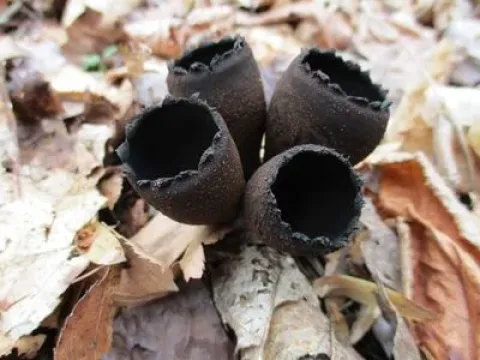
Urnula craterium
Urnula craterium
The primary visual sign of Urnula craterium is the appearance of distinct, cup-shaped fruiting bodies, commonly known as the Devil's Urn, emerging from decaying wood in early spring.
What the section contains
Urnula craterium
These fruiting bodies are dark brown to black in color, with a leathery texture. They are typically attached to the substrate by a short, sturdy stalk that may be partially buried.
The interior of the cup is smooth, while the exterior is covered in fine, hair-like structures, making it easily distinguishable from other cup-fungi found in similar habitats.
The presence of this fungus often indicates advanced stages of wood decay in host trees, as the mycelium penetrates deep into the lignified tissues to extract nutrients.
Affected wood often shows signs of bleaching or discoloration along with structural softening, which can be observed if the bark is removed or during tree surgery.
Urnula craterium is an ascomycete fungus that serves as a specialized saprotroph, primarily colonizing dead or dying hardwood species such as oak and beech.
The fungus produces apothecia which serve as the reproductive structures. Within these structures, asci containing spores are formed and released into the atmosphere during favorable weather conditions.
Spores are dispersed by wind currents, allowing the fungus to colonize new substrates over significant distances when conditions are appropriate for germination.
The fungal mycelium secretes powerful extracellular enzymes that break down lignin and cellulose, enabling it to thrive on woody material that other organisms find difficult to decompose.
Genetically, this species is well-adapted to the temperate climate, showing remarkable resilience and the ability to remain dormant in wood during drier seasons.
Moisture is the most critical factor for the growth of Urnula craterium. High humidity and cool temperatures in early spring are essential for the production of fruiting bodies.
The fungus thrives in environments with ample decaying organic matter, particularly where fallen branches or logs are in direct contact with moist, nutrient-rich soil.
Temperatures ranging from 5 to 15 degrees Celsius are optimal for the growth of the mycelium and the subsequent emergence of the apothecia above the ground.
Forest floors and garden areas with poor drainage and high organic leaf litter provide the perfect environment for the fungus to establish and spread.
Dense canopies that block sunlight and promote high ground-level humidity significantly favor the rapid colonization of woody debris by this pathogen.
While primarily a saprotroph, the fungus can indirectly harm trees by accelerating the decay of damaged roots or trunk bases, leading to structural instability.
In mature trees, the presence of such decay fungi can increase the risk of windthrow, posing a hazard to infrastructure and human safety in parks or residential gardens.
The depletion of woody tissues by the fungus weakens the physical support system of the tree, making it more susceptible to environmental stresses like heavy snow or high winds.
In nursery settings, contact between healthy saplings and colonized debris can lead to premature decay, potentially causing stunted growth or the death of young plants.
The economic impact involves the loss of tree longevity and the necessity for costly arboricultural interventions to mitigate safety risks associated with decaying timber.
The most effective management strategy is rigorous sanitation, which involves the removal of deadwood, fallen branches, and decaying logs from the immediate vicinity of healthy trees.
Maintaining proper tree health through balanced fertilization and irrigation helps trees resist the conditions that favor fungal colonization near the base.
Ensuring good soil drainage around the root zone prevents the persistent dampness required for the fungus to successfully produce its fruiting bodies.
If a tree is found to be heavily colonized, especially near the roots, it should be assessed by a professional arborist to determine the extent of internal decay and stability risks.
- Regular inspection of the root collar and bark.
- Manual removal of fruiting bodies before spore release.
- Improvement of site drainage to reduce ground-level moisture.