
Uromycladium
Uromycladium
Description
Symptoms
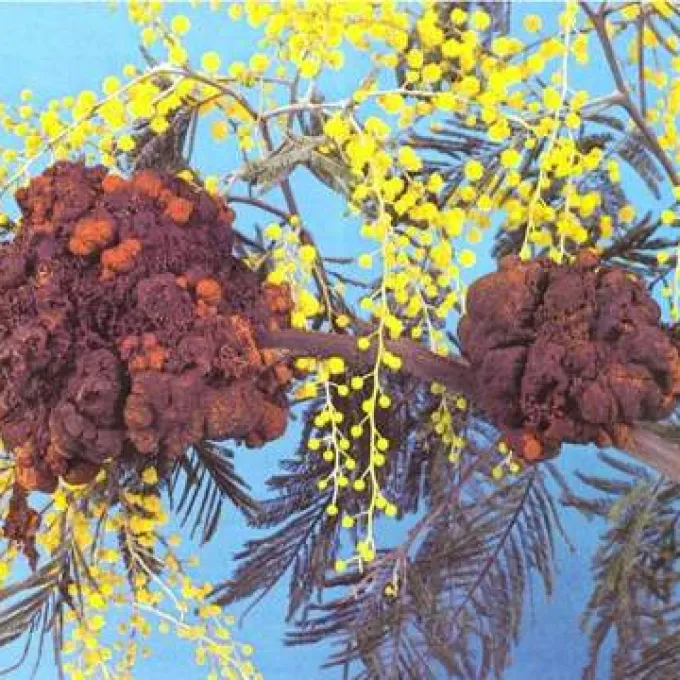
The primary symptom of a Uromycladium infection is the development of large, tumor-like galls on branches, leaf petioles, and occasionally flower stalks. These galls are distinct pathological outgrowths of plant tissue.
In their early stages, the galls are small and relatively smooth, but as they mature, they become large, knobby, and spongy. The surface often becomes covered in a brown, powdery mass of spores, which is a hallmark sign of the disease.
Infected plants show reduced vigor, as the fungal growth disrupts normal physiological processes. Leaves on affected branches may turn yellow and fall prematurely, impacting the plant’s overall photosynthetic capacity.
Structural damage is common, as the heavy galls lead to branch deformation and brittleness. These weakened branches are highly susceptible to breakage under their own weight or due to mechanical stress like wind.
- Development of knobby, tumor-like galls
- Dark brown powdery spore mass on galls
- Deformation and brittleness of affected twigs
- Premature leaf drop and canopy thinning
Pathogen
The causative agents of this disease are specialized rust fungi belonging to the genus Uromycladium. The most prominent species is Uromycladium tepperianum, which is responsible for inducing severe morphological changes in host plants.
This pathogen is an obligate parasite, meaning it relies entirely on the host plant's living tissues to complete its biological cycle. It displays a narrow host range, primarily infecting species within the genus Acacia.
The life cycle of the fungus involves the production of various spore types, facilitating its efficient dispersal and survival in diverse environments. The mycelium penetrates deeply into the plant's vascular and parenchymal tissues.
Biologically, the pathogen manipulates the host's metabolism by releasing substances that trigger uncontrolled cell division. This process results in the formation of tumor-like structures known as galls, which serve as incubation chambers for fungal reproduction.
Unlike many other rust fungi, Uromycladium is highly aggressive in specific climates. Its evolutionary adaptation allows it to colonize the host's resources efficiently, often resulting in significant plant stress and tissue decline.
Conditions for development
The development of the disease is heavily influenced by humidity levels. High ambient humidity and frequent rainfall are essential for spore germination and the subsequent infection of susceptible plant tissue.
Temperature plays a critical role in the rate of mycelial growth within the plant. Moderate, consistent temperatures favor the expansion of galls, allowing the pathogen to colonize the host more aggressively.
Spore dispersal is primarily mediated by wind currents, enabling the disease to spread rapidly across orchards or urban landscapes. Mechanical transmission via contaminated pruning tools is also a significant risk factor.
Plants under stress, whether due to nutrient deficiencies, drought, or previous mechanical injury, are significantly more susceptible to infection. Maintaining overall plant health is a key factor in natural resistance.
High planting density contributes to the spread of the disease. Crowded stands restrict airflow, which keeps foliage moist for longer periods, thereby creating an optimal microclimate for spore survival and infection.
Why it matters
The primary harm caused by Uromycladium is the systematic depletion of the plant's energy resources. The parasite effectively diverts nutrients that are vital for new shoot growth and root development.
Galls obstruct the normal flow of sap within the branches, leading to the dieback of canopy sections located distal to the infection site. This necrotic process leaves the tree vulnerable to secondary pest attacks.
Severe infestations can lead to the gradual death of young trees and a significant loss of ornamental value in mature specimens. In forestry settings, this represents a major economic impact.
The physical burden of the galls alters the architecture of the tree, making the canopy less resistant to wind damage. Branch breakage can lead to major structural failure of the main limbs.
Extended infection periods often lead to massive necrosis around the gall areas. This opens pathways for wood-decaying fungi to invade the trunk, significantly shortening the lifespan of the host plant.
Protection
Prevention is the most effective management strategy for Uromycladium. Careful selection of nursery stock, ensuring it is free of galls or suspicious growths, is essential to keep the disease out of new areas.
Sanitary pruning of all infected branches is a mandatory control measure. It is crucial to excise the galls completely, including a margin of healthy tissue, to remove the fungal mycelium entirely.
All infected plant material must be destroyed immediately, preferably through burning, to prevent further spore dispersal in the environment.
Disinfection of pruning tools after every cut is vital when dealing with infected trees. Using alcohol or copper-based disinfectant solutions prevents the inadvertent transfer of spores between trees.
In cases of heavy infestation, systemic or copper-based fungicides may be applied to protect the remaining canopy. Treatment protocols must be followed strictly to ensure efficacy and reduce the pathogen population.
Discussion
No discussions yet — be the first.