
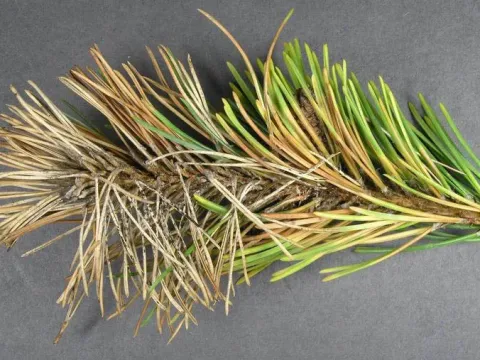
Truncatella leaf spot
Truncatella hartigii
The causative agent of the disease is the imperfect fungus Truncatella hartigii (synonym Pestalotia hartigii), which belongs to the order Sphaeropsidales. It acts as a facultative parasite.
What the section contains
Truncatella leaf spot
The fungus produces conidia within pycnidia — flask-shaped fruiting bodies that develop on the surface of infected plant tissues. These structures protect the spores until they are ready to disperse.
The conidia are characterized by distinctive appendages that aid in their dissemination by wind, rain splashes, and human activity across nursery and garden environments.
The pathogen is highly persistent, capable of surviving in dead plant debris, bark, and soil for extended periods, waiting for conditions that favor its activation.
It possesses a remarkable ability to adapt to host conditions, often colonizing tissues that have been weakened by environmental stress or secondary pests.
The primary symptoms appear as necrotic spots on leaves, petioles, and young shoots. These spots vary from brown to reddish-brown, often surrounded by a darker margin.
Small black dots, known as pycnidia, emerge within the center of these lesions. They are often arranged in concentric circles, which is a diagnostic feature of this fungal infection.
On young seedlings, the fungus causes girdling (constriction) of the stems, leading to the collapse and death of the upper plant parts, commonly referred to as damping-off or shoot blight.
Infected leaves turn yellow and drop prematurely, leading to significant defoliation. In moist conditions, a faint greyish-olive spore mass may be visible on the necrotic tissue.
Cankers and sunken lesions may form on the stems and bark of woody plants, which disrupts vascular flow and causes dieback of entire branches.
High relative humidity and consistent moisture are the most critical environmental factors that promote the germination of Truncatella spores and their penetration into host tissues.
The fungus thrives within a temperature range of 18°C to 25°C. These conditions maximize its metabolic activity and the rate of lesion expansion on the host plant.
Poor airflow, common in crowded greenhouses or dense field plantings, prevents leaves from drying out after rain or irrigation, creating an ideal microclimate for infection.
Wounds caused by frost, insect feeding, or pruning operations serve as primary entry points for the pathogen, allowing it to bypass the plant's natural external defenses.
Plants suffering from nutrient deficiencies or improper watering regimes show reduced resistance, making them significantly more vulnerable to rapid colonization by the fungus.
The disease causes significant damage by reducing the vigor and photosynthetic capacity of plants, which results in stunted growth and diminished crop yields.
In forest and fruit tree nurseries, the infection can cause high mortality rates among young seedlings, leading to severe economic losses for growers.
Early defoliation prevents the plant from accumulating necessary carbohydrate reserves, making it less hardy and more susceptible to winter injury and other stressors.
Necrotic lesions on stems can lead to permanent structural damage, rendering the plants unattractive or unusable for commercial sale in the horticultural market.
When the pathogen colonizes older woody tissues, it can lead to chronic decline, where the plant gradually loses its ability to regenerate or produce fruit.
Management strategies focus on a combination of cultural practices, sanitation, and the judicious use of chemical fungicides to prevent and limit the spread of the fungus.
Sanitation is paramount: all diseased plant parts must be pruned and destroyed immediately to reduce the inoculum load within the garden or nursery environment.
Fungicide applications, particularly those containing copper, mancozeb, or systemic triazoles, are effective when applied preventively or at the very onset of symptoms.
- Prune and remove infected twigs, ensuring cuts are made into healthy tissue.
- Sterilize pruning tools with alcohol or a bleach solution between plants.
- Improve spacing and pruning density to enhance air circulation around plants.
- Avoid overhead irrigation, especially in greenhouses, to keep foliage dry.
- Implement a balanced fertilization plan to ensure plant vigor and resilience.
Regular monitoring of nurseries and greenhouses allows for early detection, which significantly improves the success rate of control efforts and minimizes chemical use.