
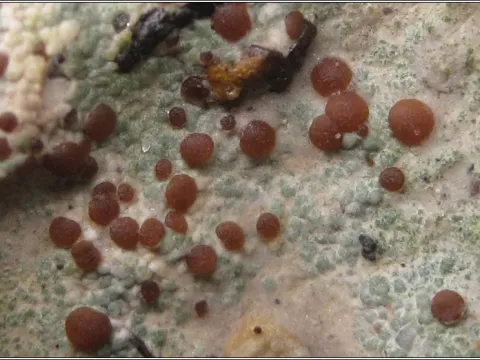
Trapelia coarctata
Trapelia coarctata
Trapelia coarctata is a crustose lichen characterized by a thick, often cracked thallus that forms a persistent coating on various rocky surfaces.
What the section contains
Trapelia coarctata
The thallus color ranges from grey to brownish-ochre, providing effective camouflage against different types of silicate and mineral substrates.
A distinctive feature of this species is the presence of numerous apothecia, which are often immersed or tightly pressed into the thallus.
The surface structure is typically areolate, with distinct segments separated by deep fissures that reveal the underlying lichen tissues.
The organism is closely adapted to its habitat, possessing a complex layered structure that maximizes the absorption of nutrients and moisture.
It is crucial to state that Trapelia coarctata is not a plant pathogen or a disease affecting agricultural crops in any way.
It is an epilithic lichen organism consisting of a fungal partner and a photobiont (green algae) living in a stable symbiotic relationship.
The lichen does not parasitize vascular plants, nor does it release toxins that could affect the health or development of cultivated crops.
Biologically, it belongs to the group of lichens, which serve as natural environmental indicators rather than agricultural pests.
The organism derives its nutrition from the environment and the substrate, completely independent of the agricultural crop production cycle.
Trapelia coarctata thrives in humid and shaded conditions, frequently colonizing sandstones, granites, and other silica-rich mineral surfaces.
Optimal environmental conditions include consistent atmospheric humidity and stable temperatures, which support the lichen's metabolic processes.
The species demonstrates high resistance to temporary desiccation, allowing it to survive in environments with fluctuating water availability.
Dispersal occurs via spores or thallus fragments, which are distributed by wind, rain, or physical contact with the rocky surface.
The presence of this species often indicates a low level of atmospheric sulfur pollution, as it is sensitive to environmental degradation.
This organism poses no harm to agricultural production, harvest yields, or the overall health of plants within an agro-ecosystem.
Any perceived damage is limited to the extremely slow long-term weathering of stone structures, which is a natural geological process.
While the lichen secretes organic acids that contribute to stone erosion, the rate is negligible over typical agricultural timeframes.
There is no risk of disease transfer to crops, and the organism does not compete with plants for soil nutrients or water resources.
In an agricultural context, it is considered an ecologically neutral component of the landscape, not requiring any mitigation strategies.
Since Trapelia coarctata is not a crop pathogen, chemical control measures such as fungicides or pesticides are completely unnecessary.
If management of stone surfaces is required, mechanical cleaning or high-pressure water washing is the most effective and safe method.
Ensuring that stone structures remain dry and well-lit can help discourage the colonization of the surface by lichen spores.
No agricultural protocols are required for this species, as it does not interfere with standard farming or crop management practices.
Maintaining biological diversity is generally encouraged, and this lichen serves as a valuable indicator of healthy, clean environments.