
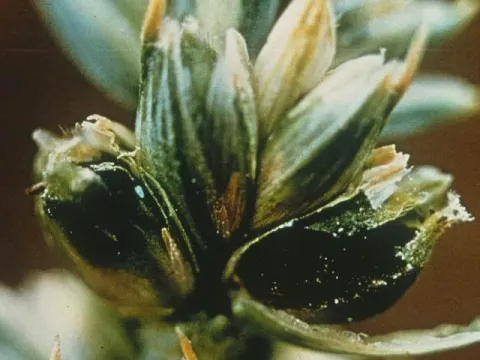
Foxtail smut
Tilletia setariae
The disease is caused by the fungus Tilletia setariae, which is a member of the Ustilaginales order. It acts as a specialized parasite, targeting primarily the foxtail grass genus (Setaria).
What the section contains
Foxtail smut
The fungus survives as teliospores in the soil or on seeds. These spores remain viable for several seasons, waiting for the right environmental conditions to germinate and infect the host plant during its emergence phase.
Systemic infection occurs early in the plant's life. The mycelium colonizes the developing tissues, moving through the stem and eventually reaching the inflorescence where the reproductive processes are hijacked.
During the heading stage, the fungal mycelium replaces the host's reproductive organs with a mass of dark, powdery spores. This transformation turns the grain into a spore-filled sac, commonly known as a smut ball.
The biology of Tilletia setariae allows it to effectively exploit the host plant's growth cycle, ensuring that the pathogen propagates successfully before the plant reaches maturity.
The most distinctive signs appear during the flowering and grain-filling stages. Affected plants exhibit deformed inflorescences that look vastly different from healthy foxtail plants.
Instead of normal seeds, the panicles contain black, soot-like masses of spores. These are covered by a thin, fragile membrane that eventually ruptures, releasing the spores into the air.
Infected plants are often stunted and show signs of chlorosis or abnormal growth patterns. The overall vitality of the plant is reduced, as energy is diverted to supporting the parasitic fungal growth.
In cases of high infection rates, the entire field population of the weed can be affected, turning the field into a source of airborne and soil-borne inoculum.
Detection is most efficient when the smut sori become visible. Because the infection is systemic, it is often too late for curative measures once the symptoms become clearly defined.
The development of foxtail smut is highly dependent on soil temperature and moisture at the time of weed seedling emergence. Cool and moist spring conditions are particularly conducive to infection.
Spores thrive in the upper soil profile, where they remain in contact with germinating seeds. Stable soil conditions enable the fungus to establish a strong presence in the field.
Agricultural practices that promote the persistence of Setaria species also promote the persistence of the fungus. Fields with a history of weed infestation are at a significantly higher risk.
Environmental fluctuations, such as extended periods of damp weather, can trigger widespread infection across larger areas, leading to significant outbreaks.
The proximity of infected wild grass reservoirs to agricultural crops increases the likelihood of spore dispersal via wind, water, and movement of farm machinery.
The primary harm is the disruption of the crop ecosystem through the heavy presence of weed pathogens. While the disease kills the weeds, the resulting spore mass contaminates the agricultural environment.
Crop contamination is a major concern. During harvesting, smut spores can coat the grain of the cultivated crops, severely downgrading the quality and marketable value of the harvest.
The accumulation of spores in the soil leads to long-term management challenges, requiring specialized strategies to prevent repeated infections in subsequent seasons.
The presence of diseased material complicates harvesting operations and may lead to increased machinery wear and the need for extra cleaning cycles to prevent the spread of contamination.
Economically, the impact is felt through increased weed management costs and potential losses due to contaminated crop products that fail to meet quality standards.
- Integrated weed management programs to reduce the density of Setaria species in fields.
- Use of high-quality, certified seed to avoid introducing fungal spores into clean areas.
- Deep plowing to bury spores, which significantly reduces their long-term viability in the soil.
- Crop rotation with non-host species to break the disease cycle and deplete the soil spore bank.
- Regular field scouting and physical removal of infected weed patches before spore release.