
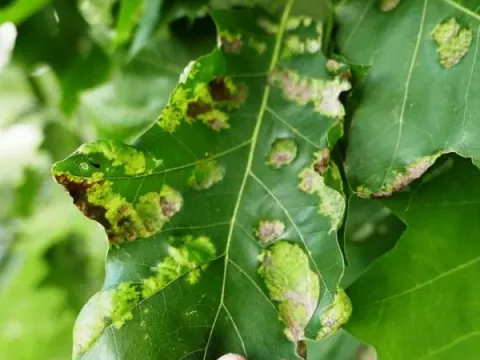
Oak leaf blister
Taphrina caerulescens
The disease is caused by the fungus Taphrina caerulescens, a specialized pathogen that infects various species of oak, particularly red oaks. It is a member of the Taphrinaceae family.
What the section contains
Oak leaf blister
The pathogen overwinters as dormant spores on the surface of buds and in the crevices of the bark. When spring conditions are favorable, these spores germinate and infect emerging foliage.
The fungus is highly specific to young, developing leaves. Once the leaf tissue has hardened and matured, it becomes resistant to new infections, making the timing of the infection very narrow.
The fungus secretes plant hormones that cause abnormal cell growth (hypertrophy) and cell division, leading to the characteristic distortion and blistering of the leaf blade.
The life cycle of Taphrina caerulescens is closely linked to moisture levels. Rain splashes facilitate the dispersal of spores from the bark to the new leaves during the critical early spring growth phase.
Symptoms appear on newly developed leaves as raised, circular, or irregular blisters. These areas are typically thickened and can be lighter in color or tinged with red or purple.
As the disease progresses, the blistered areas expand, causing the leaves to curl, twist, and deform. Severely affected leaves often look puckered and stunted.
The underside of the blisters may develop a dusty, whitish appearance. This is the result of the fungal fruiting bodies producing thousands of microscopic spores.
In cases of heavy infection, the leaves may wither and drop prematurely. This usually occurs in late spring or early summer, depending on weather conditions and tree susceptibility.
While the foliage may look unsightly, the disease rarely kills mature, healthy oak trees, though it can significantly reduce the overall aesthetic and vigor of the tree.
The development of oak leaf blister is heavily dependent on wet and cool weather during the time of bud break. Temperatures between 10°C and 18°C are considered optimal.
Continuous rainfall and high humidity provide the necessary environment for the spores to remain viable and infect the tender, developing leaf tissue.
Trees situated in low-lying areas or areas with poor air circulation are more susceptible, as moisture stays on the leaves for longer periods, facilitating infection.
A warm and dry spring acts as a natural control, preventing the spread of the fungus and limiting the damage to the very first flush of leaves.
Young trees, newly planted specimens, or trees under stress are more likely to show severe symptoms compared to established, vigorous trees in ideal growing conditions.
The primary concern regarding oak leaf blister is the premature defoliation of the tree. This reduces the photosynthetic capacity of the oak during the critical early growth season.
Repeated annual infections can weaken the tree's health, making it more susceptible to secondary stressors such as wood-boring insects, root pathogens, and drought conditions.
In ornamental and urban landscapes, the aesthetic impact is significant. The distorted and discolored leaves detract from the tree's value as an important landscape feature.
While infection is usually not fatal for large, mature oaks, chronic loss of foliage over several years can lead to stunted growth and branch dieback in sensitive species.
Nurseries may suffer economic losses due to the unsightly appearance of infected seedlings, which makes them unsuitable for sale and may stunt their development.
Management usually involves a single fungicide application in the late dormant season, before bud break, to eliminate overwintering spores on the tree surface.
Sanitation is a key component of control. Collecting and removing fallen leaves in the autumn reduces the amount of inoculum available for infection the following spring.
Ensuring good tree health through proper watering, mulching, and fertilization helps the tree resist the negative effects of the infection and recover more quickly.
Selecting oak species that are naturally more resistant to Taphrina caerulescens is the most sustainable approach for long-term landscaping and reforestation efforts.
- Apply copper-based fungicides before bud break.
- Remove and destroy leaf litter in the fall.
- Prune to improve air circulation within the canopy.
- Promote tree vigor through proper care and maintenance.