
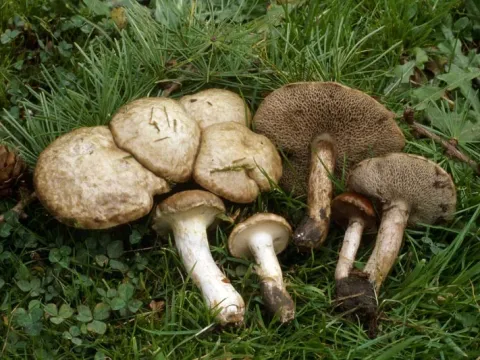
Larch bolete
Suillus viscidus
The Larch bolete (Suillus viscidus) is a basidiomycete fungus belonging to the Suillaceae family. It is not a plant disease, but rather an obligate mycorrhizal symbiont essential for the forest health.
What the section contains
Larch bolete
This fungus establishes a specific symbiotic relationship with the roots of trees in the genus Larix (larch). The fungal mycelium forms a sheath around the root tips, which is known as ectomycorrhiza.
Through this symbiotic connection, the fungus assists the tree in the uptake of water and essential mineral nutrients, particularly phosphorus and nitrogen, from the soil.
The life cycle involves the production of spores within the tubular layer of the fruit bodies. These spores are dispersed to colonize new areas, ensuring the propagation of the fungal network.
Classifying this organism as a disease is biologically incorrect, as its activity does not lead to tissue necrosis or plant death, but rather promotes plant vigor.
The most visible sign of the fungus is the emergence of fruit bodies near the base of larch trees. The cap is characterized by a slimy surface, which can vary from greyish to brownish.
The underside of the cap features large, angular pores. In young specimens, a membranous partial veil covers the pores; as the mushroom matures, the veil tears, leaving a distinct ring on the stem.
The flesh is typically dense and does not change color significantly when cut. The stem often displays a reticulated pattern above the ring.
Fruit bodies appear from mid-summer through autumn, appearing in waves that are strongly correlated with periods of high rainfall and moderate temperatures.
The presence of mycelium in the soil is typically invisible, yet it is a vital component of the larch rhizosphere, indicating a healthy symbiotic environment.
The development of the Larch bolete requires the proximity of living larch roots, as it is a host-specific species. Favorable conditions include high soil moisture and moderate ambient temperatures.
The fungus thrives in soils with good aeration and appropriate drainage, which prevents the waterlogging of the mycelial network.
Temperature fluctuations are crucial for the development of fruit bodies. Ideal growth occurs when temperatures are between 15°C and 22°C with high relative humidity.
Exposure to sunlight, often found on forest edges, can stimulate the fruiting process, provided that the soil beneath the canopy remains sufficiently cool and damp.
Human activities, such as excessive fertilizer use or soil compaction, can disturb the delicate balance required for the mycorrhizal network to survive.
The Larch bolete is not a plant pathogen; it does not cause economic loss or damage to agricultural or forestry crops. It is beneficial for the growth and development of larch plantations.
There is no evidence of this fungus causing decay, wilt, or any other pathological symptom in trees. Its interactions are confined to the beneficial exchange of nutrients.
In fact, the absence of mycorrhizal partners can lead to nutrient deficiency in larch trees, making them more susceptible to actual diseases and environmental stressors.
The fungus has positive economic value, as it is a recognized edible mushroom, appreciated by forest visitors and mushroom pickers.
No protective measures are required to manage this fungus, as it is a natural component of healthy coniferous forests.
As the Larch bolete is a beneficial organism, no control or eradication measures are necessary or recommended.
Forest management practices should focus on maintaining natural soil health and avoiding the overuse of broad-spectrum fungicides that could harm beneficial fungal life.
If disease control is required for other pathogenic fungi in the area, foresters should select targeted treatments to preserve the symbiotic mycorrhizal community.
Preservation of the existing forest floor and prevention of excessive soil disruption are the best ways to encourage the presence of this fungus.
Overall, monitoring for the presence of such symbionts can serve as an indicator of a thriving and resilient forest ecosystem.