
Larch needle cast
Hypodermella laricis
Description
Symptoms
Initial symptoms are visible in early summer, characterized by a transition in needle color from healthy green to a dull yellowish-brown or straw color. This change is often rapid and occurs across large portions of the crown.
The most prominent sign is the premature needle drop, which occurs much earlier than natural senescence. The affected branches appear thin or partially bare by mid-summer, significantly affecting the tree's silhouette.
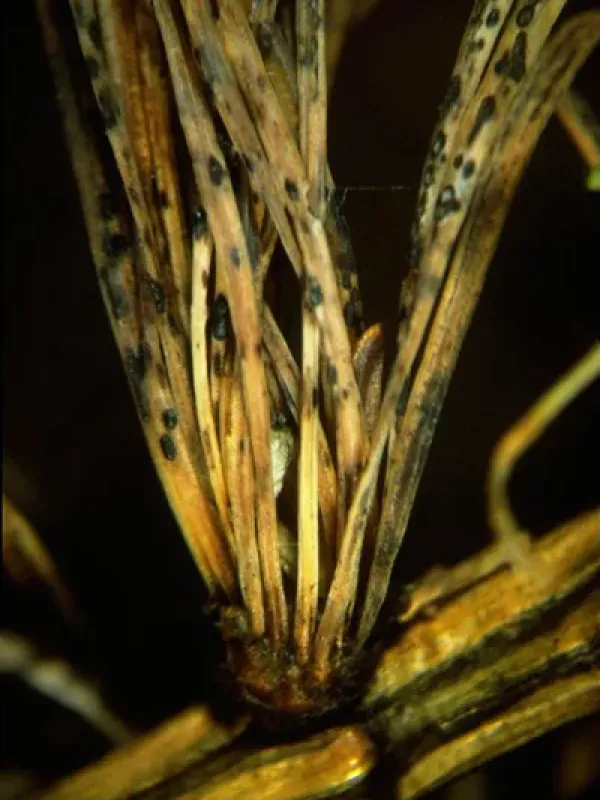
Under close inspection, the needles exhibit dark, elongated fruiting bodies (apothecia) arranged in lines. These structures are diagnostic and distinguish Hypodermella laricis from other needle-cast pathogens.
In humid conditions, a fine dusting of spores may be visible on the needles. The pattern of infection is often uneven, leading to a mottled appearance as clusters of needles die off while others remain temporarily green.
As the infection progresses, the needles become brittle and necrotic. Chronic infections result in a sparse canopy, stunted terminal growth, and a generally sickly appearance of the entire tree.
Pathogen
The disease is caused by the fungus Hypodermella laricis, an obligate parasite that specifically infects larch trees. It is a member of the Ascomycota phylum, relying on living larch needles to complete its life cycle.
The fungus overwinters on fallen needles, where it develops its reproductive structures known as apothecia. These structures appear as narrow, dark, longitudinal lines on the dead needles by the spring season.
Infection begins when ascospores are released from the apothecia, triggered by high humidity and rain. These spores are dispersed by wind to healthy, developing needles, where they germinate and colonize the needle tissues.
The fungal mycelium spreads within the needle tissue, breaking down cellular structures and chloroplasts. This disruption of the photosynthetic apparatus is what leads to the characteristic color changes in the foliage.
The pathogen is highly host-specific to the Larix genus. Its survival depends entirely on the availability of new needles each growing season, making it a persistent resident in larch-dominated ecosystems.
Conditions for development
High moisture levels are the primary driver of needle cast outbreaks. Frequent rainfall, dew, and persistent fog during the late spring and early summer months provide the perfect environment for spore release and infection.
Stands with high planting density are particularly susceptible because they lack proper air circulation. Stagnant air keeps the foliage wet for longer periods, facilitating the colonization of the fungal spores.
The presence of old, infected needle litter under the trees acts as a continuous source of inoculum. Without management of this forest floor debris, the fungus will continue its life cycle year after year.
Trees that are under physiological stress, due to drought, poor soil nutrients, or insect herbivory, are more easily colonized. Improving the overall vigor of the host plant is essential for disease management.
Mild to warm temperatures ranging from 15°C to 22°C are optimal for fungal growth. During these temperature windows, the pathogen reaches its peak metabolic activity and reproductive potential.
Why it matters
The primary harm caused by larch needle cast is the significant reduction in the tree's photosynthetic capacity. This loss of foliage leads to diminished energy reserves and reduced annual height and diameter growth.
In nursery settings, the infection causes severe economic losses. Infected saplings lose their aesthetic and commercial value, often becoming stunted and unsuitable for sale or reforestation projects.
Prolonged defoliation weakens the host tree, making it more vulnerable to secondary invaders. Opportunistic insects, such as bark beetles, are more likely to attack trees already stressed by needle cast.
In forestry, persistent infection leads to delayed rotation periods and reduced timber yield. The quality of the wood can also suffer due to the overall decrease in tree health and resilience.
For ornamental landscapes, the loss of foliage results in a negative impact on aesthetics. The cost of chemical management and restoration of the canopy in public parks and gardens can be substantial.
Protection
The most effective management strategy is sanitation: raking and destroying fallen needles to eliminate the primary source of infection. This disrupts the fungal cycle and prevents new infections from establishing.
When establishing new plantations, maintain adequate spacing between trees to ensure good air movement. Proper site selection and site preparation are crucial for preventing long-term humidity issues in the crown.
Chemical control involving fungicides can be used for high-value ornamental trees. Applications should be timed specifically to the spring season when spores are actively being released to be most effective.
Promote host vigor through appropriate fertilization and site management. Balanced nutrition helps the tree defend itself more effectively, while avoiding over-fertilization prevents overly lush, vulnerable needle growth.
Monitor stands regularly to detect early signs of the disease. If isolated pockets of infection occur, perform selective pruning of the affected branches to reduce the amount of inoculum present in the immediate area.
Discussion
No discussions yet — be the first.