
Larch endoconidiophorosis
Endoconidiophora laricicola
Description
Symptoms
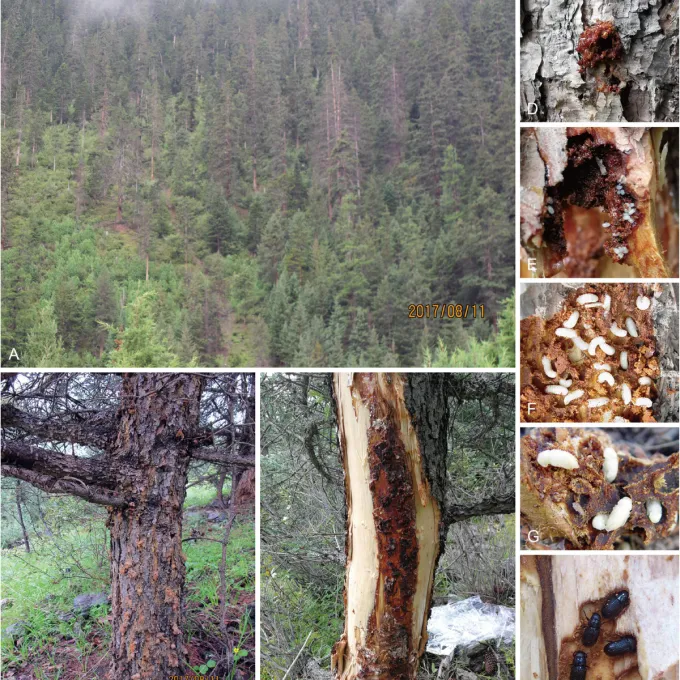
The most evident symptom of endoconidiophorosis is the premature discoloration of the crown. Needles begin to turn yellow, subsequently progressing to a reddish-brown hue, signaling severe stress and water deficiency.
When the bark is removed, characteristic discoloration of the inner bark and sapwood is visible. The wood may display dark blue, grey, or black streaks, which are clear signs of fungal mycelium colonizing the vascular tissues.
Trees often respond to the infection by producing excessive resin. Resin bleeding on the surface of the bark is a defensive mechanism, yet it is rarely successful in halting the progression of the pathogen once established.
On the bark surface, one may observe entry and exit holes created by the insect vectors. Surrounding these holes, the inner tissue often shows signs of necrosis, separating from the wood as the tree's health deteriorates.
In advanced stages of the disease, the bark may peel away from the trunk. The exposed wood reveals significant structural decay, becoming brittle and losing its mechanical integrity, which eventually leads to the tree's death.
Pathogen
The causative agent of larch endoconidiophorosis is the ascomycete fungus Endoconidiophora laricicola. This pathogen has a highly specialized relationship with bark beetles and other wood-boring insects, which serve as its primary vectors.
The fungus develops within the conductive tissues of the tree trunk. By forming endoconidia, the pathogen exploits the movement of insects under the bark to infiltrate healthy tissues, ensuring the rapid spread of the infection.
This organism is a specific parasite primarily targeting larch species. It penetrates the sapwood, disrupting the vital physiological processes responsible for water and nutrient transport throughout the tree.
The disease is categorized as a vascular pathogen that induces necrotic lesions. Its activity leads to systemic disruption, as the fungal mycelium colonizes the cambium and xylem, causing permanent damage to the tree's health.
The fungus’s life cycle is strictly synchronized with the activity of its insect hosts. Without the presence of these wood-boring pests, natural transmission of the fungus is significantly limited, highlighting its obligate ecological dependency.
Conditions for development
The primary factor facilitating the infection is physical damage to the bark caused by insects. This injury provides the necessary entry point for fungal spores to colonize the interior of the tree.
Environmental conditions characterized by high humidity and moderate temperatures during the growing season significantly promote the growth and dissemination of the pathogen.
Trees weakened by external stressors such as prolonged drought, fire damage, or over-dense planting are significantly more susceptible to endoconidiophorosis, as their natural defense systems are compromised.
Inadequate forest management, such as leaving logging residues in the forest, creates optimal breeding grounds for bark beetles, which in turn increases the pathogen's dispersal capacity.
Microclimatic factors also play a critical role; dense stands that lack proper aeration maintain a humid environment near the trunks, which favors the persistent development of the fungal infection.
Why it matters
The most significant impact of endoconidiophorosis is the rapid mortality of larch stands. By paralyzing the tree's vascular system, the fungus causes the tree to dry out and die within a relatively short period, often just one or two growing seasons.
Mass infestations lead to substantial economic losses in the forestry sector. Timber from infected trees loses its quality and marketability due to the internal discoloration and decay, rendering it unsuitable for high-grade construction.
Outbreaks of the disease necessitate costly sanitation operations, including the removal of dead or dying trees, which disrupts forest ecosystems and requires long-term planning for reforestation.
The presence of the disease alters the forest structure, potentially leading to fragmented habitats. This creates voids in the forest canopy that can affect local biodiversity and environmental stability.
Infected trees become reservoirs for other secondary fungal pathogens and pests, triggering a cascading effect of forest degradation that extends far beyond the original site of infection.
Protection
Rigorous sanitary monitoring is the cornerstone of prevention. Early detection of infested trees allows for their prompt removal before the pathogen and its insect vectors can spread to neighboring healthy stands.
Effective forest management practices, such as maintaining appropriate stand density and timely cleaning of logging areas, help build healthier forests that are more resilient to pathogen attacks.
The deployment of pheromone traps to manage bark beetle populations is a crucial indirect control measure, significantly reducing the transmission of the fungal spores within the forest.
Chemical control, while usually impractical for large forest areas, can be employed in specialized nursery settings or high-value plantations using targeted fungicides during periods of high vector activity.
Adherence to quarantine regulations regarding the transport of raw timber is essential. Preventing the movement of wood from infected zones is a vital step in containing the disease and protecting non-infected regions.
Discussion
No discussions yet — be the first.