
Larch canker
Lachnellula willkommii
Description
Symptoms
The primary symptom of larch canker is the formation of localized necrotic lesions on the bark, which eventually develop into distinct, sunken cankers often surrounded by callus tissue.
In the affected areas, the bark may crack, and resin flow is commonly observed as the tree attempts to defend itself against the invasion of the fungal mycelium.
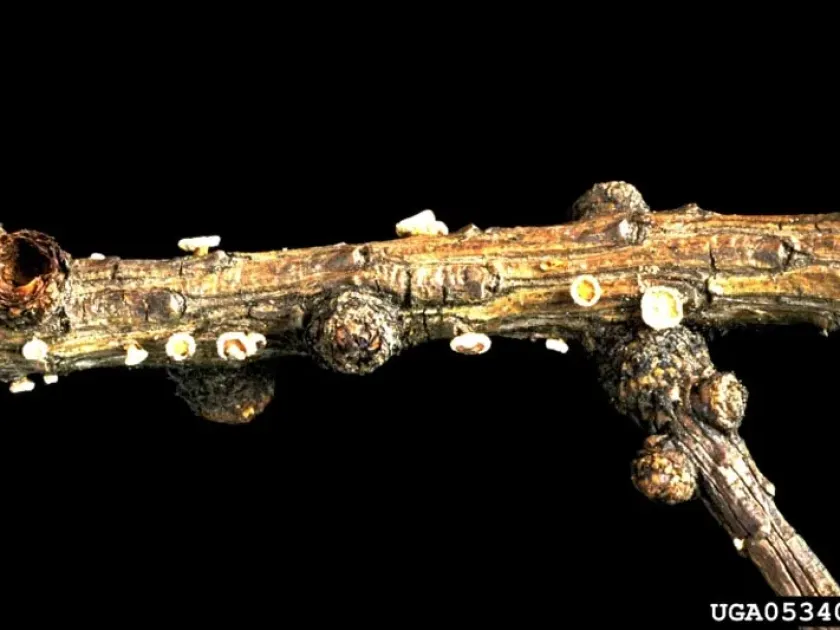
During moist periods or in early spring, the orange, cup-like fruiting bodies of the fungus emerge at the margins of the cankers, serving as a diagnostic visual indicator of the disease.
Young trees are particularly susceptible to severe damage, often suffering from stem deformation, tip dieback, or even complete girdling, which leads to the death of the crown.
In older trees, the progression of the disease causes a significant loss of vigor, characterized by yellowing and premature needle drop, ultimately reducing the tree's ability to thrive.
Pathogen
Larch canker is caused by the ascomycete fungus Lachnellula willkommii. This pathogen is a highly specialized parasite that primarily attacks larch trees in both managed forests and natural stands.
The fungus reproduces through small, cup-shaped fruiting bodies known as apothecia, which are typically orange or cream-colored and appear on the bark of infected branches and stems during wet conditions.
The mycelium of the pathogen penetrates deeply into the bark and cambium layers. By doing so, it disrupts the tree's vascular system, preventing the transport of nutrients and water throughout the trunk.
Spore dispersal occurs mainly through wind and splashing raindrops. These spores can travel significant distances, allowing the disease to spread rapidly throughout a forest stand in favorable weather.
Lachnellula willkommii is a persistent pathogen capable of surviving within the host tissue for many years, progressively expanding the canker area and leading to the eventual decline of the tree.
Conditions for development
The development of the disease is heavily influenced by high humidity and moderate temperatures. Prolonged rainy weather is critical for the germination and spread of fungal spores.
Frost damage and winter injury, which cause cracks in the bark, provide primary entry points for the pathogen to infect the host tissue, especially in regions with sharp temperature fluctuations.
Dense, unthinned stands restrict airflow and maintain a humid microclimate, which creates an environment where the fungus can reproduce and infect neighboring trees with greater efficiency.
Trees that are already under physiological stress due to poor soil conditions, nutritional deficiencies, or competition are much more prone to succumbing to the pathogen's attack.
Human activity, such as improper pruning or mechanical injury during forest management operations, creates wounds that facilitate easy entry for the fungus into healthy trees.
Why it matters
Larch canker is regarded as one of the most damaging diseases for young larch plantations, frequently causing high mortality rates and forcing the total removal of affected stands.
Beyond tree death, the disease causes major degradation of timber quality. Cankers and wood necrosis render the logs unsuitable for high-quality structural construction or manufacturing.
The reduction in annual growth increments due to damaged vascular systems translates into significant financial losses for the forest industry over the long term.
Infected stands often exhibit lower resilience, making them more attractive to secondary wood-boring insects, which further accelerates the rate of tree mortality within the area.
The management of infected sites requires extensive sanitary interventions, which increase operational costs and divert resources away from other forest development tasks.
Protection
Successful management begins with the selection of resistant larch species or provenances that are well-adapted to the local environment, reducing the overall risk of infection.
Sanitary thinning is essential; all infected trees must be identified, removed, and burned to eliminate the source of inoculum and prevent further spread of the fungal spores.
- Regular site inspections to identify early symptoms of cankers.
- Maintaining optimal stand density to ensure adequate air circulation.
- Careful handling of trees to avoid mechanical bark injuries.
- Sterilization of pruning tools to prevent cross-contamination.
- Targeted application of fungicides in nurseries when infection pressure is high.
Improving general tree health through balanced fertilization and proper silvicultural care helps the tree build natural defenses that can slow the progress of the canker.
Proactive monitoring allows for the early detection of disease outbreaks, enabling forest managers to implement containment strategies before the infection spreads to healthy parts of the stand.
Discussion
No discussions yet — be the first.