
Phytophthora root rot of soybean
Soybean
The causative agent of this disease is the oomycete Phytophthora sojae. It is a soil-borne pathogen capable of persisting in the soil for years as dormant oospores.
What the section contains
Phytophthora root rot of soybean
Biologically, this organism belongs to the oomycetes group, making its lifecycle highly dependent on soil moisture and water availability in the field.
This pathogen is highly specialized and targets only soybean plants. It spreads primarily through motile zoospores that swim through water films in the soil.
There are numerous physiological races of the pathogen, which poses a significant challenge for plant breeders attempting to develop resistant soybean varieties.
The pathogen can infect soybeans at any stage, from germination to maturity, making it a persistent threat throughout the entire growing season.
Early symptoms often include pre-emergence damping-off, where seeds rot in the soil before they can even germinate or sprout.
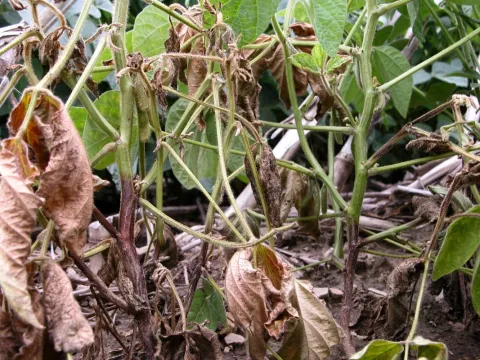
In older plants, symptoms typically manifest as wilting and yellowing of the leaves, which eventually turn brown and fall off as the plant dies.
A diagnostic sign is the presence of a brown, necrotic lesion that extends from the roots up the stem, often reaching several nodes above the soil line.
Affected plants are significantly stunted compared to healthy ones, and their root systems often appear rotten, lacking healthy lateral roots.
Under high humidity conditions, a sparse, white mycelial growth may appear on the lower stems, although this is not always visible to the naked eye.
Phytophthora root rot is favored by high soil moisture levels. It is most prevalent in heavy, clayey soils that are prone to waterlogging after heavy rains.
The optimal temperature range for the infection is between 15°C and 25°C, which coincides with the time of planting and seedling establishment.
Poor field drainage is the primary environmental factor contributing to the development of the disease, as it allows zoospores to reach the plant roots.
Soil compaction and the formation of a hardpan layer restrict water infiltration, keeping the root zone saturated and creating ideal conditions for the pathogen.
Low-lying areas of a field are usually the first to show symptoms because they accumulate water, facilitating the rapid spread of the pathogen's zoospores.
The economic impact of the disease is significant, as it leads to poor stand establishment and, in severe cases, the total loss of the crop in infected areas.
Infection damages the root system, which prevents the plant from absorbing water and nutrients efficiently, leading to reduced pod fill and lower yields.
Seeds from infected plants are often smaller and of lower quality, which affects marketability and seed stock vigor for the following season.
Increased vulnerability to other soil-borne pathogens is a common consequence, as the plant's natural defenses are compromised by the initial infection.
Farmers often face increased production costs due to the need for fungicide treatments and potential reseeding of damaged parts of the field.
The primary control measure is the use of resistant or tolerant soybean varieties, although the effectiveness of this approach depends on the local race composition.
Crop rotation with non-host crops is essential to reduce the inoculum levels of oospores present in the soil over time.
Improving soil drainage through tiling or deep cultivation can significantly decrease the risk of water stagnation and subsequent infection.
Seed treatment with specific fungicides targeting oomycetes is a critical management practice for protecting seedlings during the early, vulnerable stages.
Avoiding soil compaction by limiting heavy machinery traffic when the soil is wet helps to maintain better aeration and reduces the conditions favorable for the fungus.