
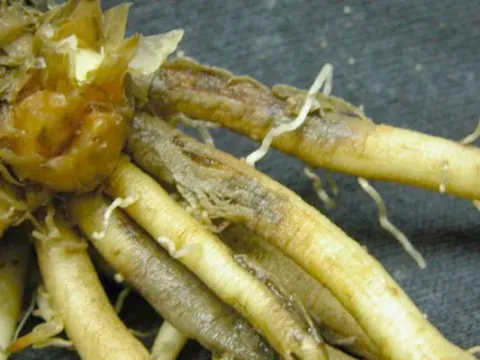
Phytophthora spear rot
Phytophthora asparagi
The disease is caused by the oomycete Phytophthora asparagi, a soil-borne pathogen known for its persistence in diverse agricultural environments.
What the section contains
Phytophthora spear rot
The life cycle of this organism is heavily dependent on moisture, as it produces motile zoospores that move freely in saturated soil environments.
The pathogen primarily infects the crown and root system of asparagus, colonizing the tissues and disrupting the plant's vascular integrity.
It can produce thick-walled oospores that act as survival structures, allowing the pathogen to remain viable in the soil for several years.
As an oomycete, it thrives in environments that are poorly aerated and waterlogged, which facilitates the spread of infection between adjacent plants.
The initial signs of infection often appear as a general yellowing or chlorosis of the foliage, followed by progressive wilting of the asparagus ferns.
Underground spears and root systems exhibit water-soaked lesions that eventually turn reddish-brown or dark brown in color.
The affected roots become soft, mushy, and eventually rot, losing their ability to take up water and nutrients from the soil.
Infected crowns may show signs of decay, appearing shriveled and dark, which severely impacts the plant's overall vigor and productivity.
During wet periods, the rot may progress rapidly, leading to the total collapse of young spears before they even break the soil surface.
The primary factor for disease development is high soil moisture levels, typically caused by excessive rainfall or inadequate drainage.
Phytophthora asparagi spreads most efficiently when soil pores are filled with water, allowing zoospores to migrate toward host roots.
The pathogen is most active in warm to moderate temperatures, which coincide with the rapid growth phase of the asparagus spears.
Heavy soils with high clay content are particularly conducive to the buildup of moisture, creating a persistent risk for root rot outbreaks.
Poor agricultural practices, such as over-irrigation and planting in low-lying areas, significantly increase the risk of disease establishment.
This disease can cause significant economic losses by reducing the marketable yield and thinning the stand on asparagus farms.
Continuous infection leads to the long-term decline of the asparagus crown, making the crop unproductive over several seasons.
Once established in the field, the pathogen is extremely difficult to eradicate, often necessitating the abandonment of the affected plot.
The quality of the spears is compromised, as they become soft and prone to secondary rot, rendering them unsuitable for market distribution.
Damage to the root system forces the plant to divert energy toward recovery, resulting in stunted growth and weakened ferns for subsequent years.
Strategic site selection is paramount; asparagus should only be planted in fields with excellent soil drainage and aeration.
Adherence to a long-term crop rotation cycle is essential to reduce the inoculum density of Phytophthora asparagi in the field soil.
Utilizing certified, disease-free planting material helps prevent the initial introduction of the pathogen into new farm areas.
Chemical control involving fungicides specifically labeled for Phytophthora species can be utilized as part of an integrated management program.
- Implementing raised bed systems to enhance water drainage.
- Removing and destroying highly infected plants and debris.
- Monitoring irrigation levels to avoid soil saturation during the growing season.