
Slafractonia
Slafractonia
The primary sign of Slafractonia infection is the appearance of chlorotic spots on the leaf blade, which eventually acquire a characteristic grayish hue. The borders of the affected areas are often outlined with a dark rim, indicating an active tissue necrosis process.
What the section contains
Slafractonia
In the progressive stage of the disease, pathogen sporulation develops on the underside of the leaf as a thin, cobweb-like coating. Under high humidity conditions, the spots begin to merge rapidly, covering significant areas of the leaf surface.
Stems of infected plants may become covered with longitudinal ulcers, which disrupts normal sap flow within the organism. Eventually, the plant begins to yellow prematurely, and the leaves begin to shed long before the end of the growing season.
Upon examination of the root system, characteristic browning of the tissues is observed, indicating a systemic nature of the infection. In advanced cases, the affected organs completely lose turgor, leading to the rapid death of the plant without the possibility of recovery.
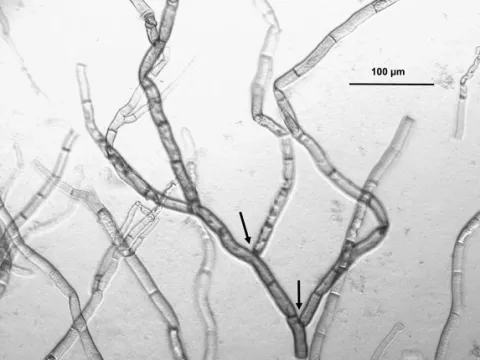
To establish an accurate diagnosis under field conditions, agronomists perform a visual inspection of leaf axils and the stem base. Detection of microscopic structures typical for Slafractonia on tissue cross-sections is a confirming factor of infection.
The causative agent of this disease is a specialized pathogenic fungus from the group of imperfect fungi, known as Slafractonia. It possesses a high degree of adaptability to various temperature regimes of the external environment.
The life cycle of the pathogen includes a spore formation stage, which are easily carried by air currents and water droplets. This mechanism ensures the rapid spread of the infection to adjacent areas of the field even at moderate wind speeds.
The pathogen is capable of maintaining viability in plant residues present in the topsoil for a long period. Such persistence creates significant difficulties for controlling the disease in monoculture conditions.
The fungus penetrates plant tissues primarily through natural openings or epidermis damage. Once inside, the mycelium begins to actively absorb nutrients, depleting the energy resources of the crop plant.
The genetic plasticity of this microorganism allows it to overcome the natural immunity of many plant varieties. This is precisely why breeding work to create resistant hybrids is an extremely complex and long-term task.
The development of Slafractonia is most intense at high air humidity exceeding 85 percent. Such conditions create an optimal microclimate for the germination of fungal spores on the surface of leaves.
The optimal temperature range for the active growth of the pathogen is considered to be between 18 and 24 degrees Celsius. In these conditions, the incubation period of the disease is reduced to a minimum, leading to epiphytotics.
Excessive application of nitrogen fertilizers, which provokes excessive growth of vegetative mass, also contributes to the development of the disease. Loose, watery tissues become easy prey for the fungal mycelium.
Poor planting schemes and excessive plant density create stagnant air, which prevents rapid evaporation of moisture. A constantly moist environment within crop stands acts as a catalyst for the start of mass infection.
The presence of weeds in the field or in adjacent areas often acts as an infection reservoir. Weeds can maintain the fungal population throughout the entire growing season even in the absence of the main crop.
The main damage caused by Slafractonia lies in the significant reduction of the photosynthetically active leaf surface area. This leads to a critical deficit of organic substances necessary for the formation of a quality crop.
Massive infection of crops can lead to a decrease in yield quantitative indicators by 30 to 50 percent. The quality of the resulting produce also deteriorates sharply, making it unsuitable for long-term storage or processing.
The appearance of marketable fruits or seeds suffers due to the development of necrosis and changes in pigmentation. This reduces the market value of the harvest and limits export opportunities for agricultural products.
Systemic infection weakens the plant's immune system, making it vulnerable to secondary pathogens and pests. Ultimately, the overall viability of the crops drops, requiring additional expenses to rescue the culture.
Economic losses include not only direct damages from reduced crop mass but also the need for additional expensive chemical treatments. This significantly increases the cost price of the final agricultural product.
Prevention of Slafractonia begins with adherence to proper crop rotation, which allows interrupting the pathogen's development cycle. It is recommended to return the crop to the same field no sooner than after three years.
An important stage is deep plowing or complete destruction of post-harvest residues where the fungus can overwinter. High-quality plowing significantly reduces the soil's infection background before the start of the new season.
The use of seeds that have undergone high-quality treatment helps prevent early seedling infection. Fungicidal treatment of planting material is a basic standard of modern agronomy.
During the growing season, it is recommended to monitor crops and apply systemic fungicides at the first signs of the disease. The correct choice of preparation should be based on the current disease development phase and weather conditions.
- Use of resistant crop varieties.
- Maintaining optimal planting density for airflow.
- Balanced mineral nutrition with an emphasis on potassium.
- Regular eradication of reservoir weeds.