
Slaty saddle
Helvella lacunosa
Description
Symptoms
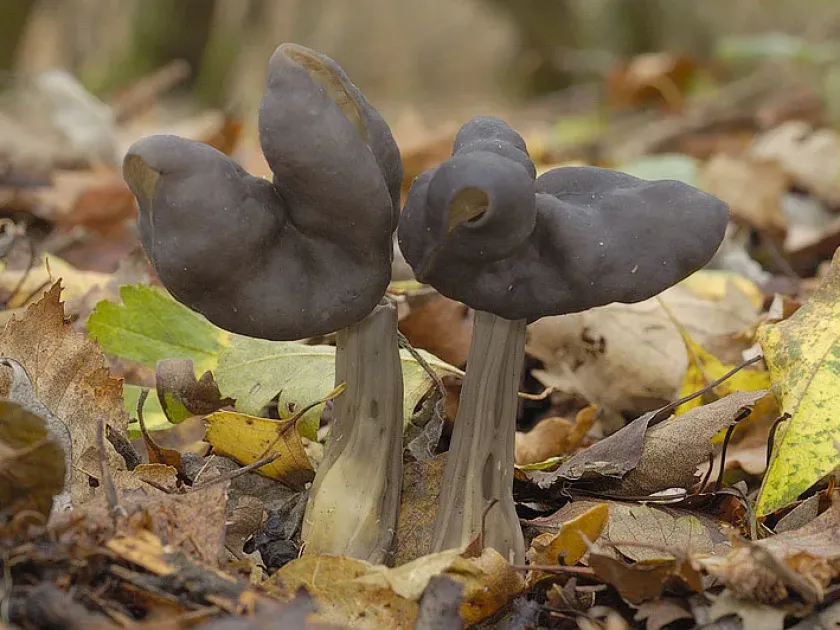
The fruiting body of the Helvella lacunosa has a characteristic folded, almost black or dark gray cap, which resembles a saddle or lobes in shape.
The stem of the fungus is distinguished by its pronounced lacunose and ribbed texture, often hollow inside, which is a key morphological feature.
The fungus does not form specific symptoms on leaves, stems, or fruits of agricultural crops, as it does not enter into parasitic relationships.
The presence of the fungus in a garden or field only indicates the presence of sufficient humus, fallen leaves, or woody debris.
The appearance of the fungus is quite recognizable, so it is rarely confused with real phytopathogenic organisms during field diagnosis.
Pathogen
Slaty saddle (lat. Helvella lacunosa) is not a pathogen of agricultural crops. This is a saprotrophic fungus from the Helvellaceae family, belonging to the Ascomycota division.
This fungus feeds on decomposing organic matter, primarily of woody origin, and does not infect living plant tissues or roots.
In an agronomic context, it is mistakenly identified as a pest due to the appearance of fruiting bodies near forest belts or orchards where decaying wood is present.
The fungus mycelium develops in the litter, actively participating in the process of soil humification, which, conversely, helps improve the mineral nutrition of forest ecosystems.
Thus, the biological nature of this object is classified as a beneficial reducer rather than a plant disease pathogen.
Conditions for development
The development of fruiting bodies occurs primarily under humid conditions, during periods of moderate air temperature typical of autumn.
The fungus prefers shaded areas rich in humus, where high soil moisture is maintained for a long period.
Spore dispersal is carried out by air currents, and for germination, a substrate with a high content of lignin and cellulose is required.
Agricultural practices, such as excessive soil moisture or leaving large amounts of woody debris in the field, can contribute to population growth.
To prevent excessive growth of the mycelium, it is sufficient to follow the rules of sanitary clearing of the site from rotting wood.
Why it matters
This object does not cause harm to agricultural plants, as it is strictly a saprotroph and does not use living plants as hosts.
The main danger is related to the toxicity of the fruiting bodies for humans if accidentally ingested, as they contain gyromitrin-like substances.
The lack of phytopathogenicity means that an agronomist does not need to use fungicides to control this species in crops.
Damage can be indirect if the mycelium actively grows in the root zone of seedlings, creating competition for nutrients in the soil.
However, in most cases, the presence of Helvella lacunosa is an indicator of healthy soil condition rich in organic components.
Protection
Specialized protection measures are not required, as the fungus does not threaten the yield of agricultural crops or plant health.
As a preventive measure to limit the spread of fruiting bodies, it is recommended to timely remove wood residues and large plant debris from the plot.
Regular maintenance of inter-row spaces and maintaining an optimal soil moisture regime allow preventing conditions for fungal growth.
Chemical treatment against this object is inappropriate and economically unjustified, considering its role in the natural cycle.
Upon detection of Helvella lacunosa, it is sufficient to perform mechanical removal of fruiting bodies to prevent sporulation near cultivated plantings.
Discussion
No discussions yet — be the first.