
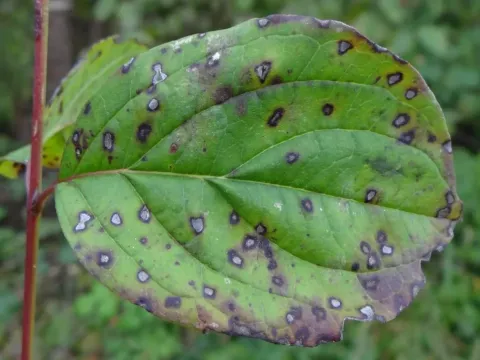
Septoria leaf blotch
Septoria adanensis
Septoria leaf blotch, caused by the fungus Septoria adanensis, is a significant fungal disease affecting various agricultural crops. It belongs to the order Sphaeropsidales and primarily targets the foliage of host plants.
What the section contains
Septoria leaf blotch
The fungus develops internally within the plant tissue, creating a network of mycelium. Key diagnostic structures, known as pycnidia, form as small, dark spots within the lesion, producing pycnidiospores that facilitate the spread of the infection.
The pathogen survives on crop debris left in the field after harvest. This ability to persist in soil or on stubble makes it a resilient threat that can carry over from season to season if proper management is not implemented.
Infection cycles begin when spores are splashed onto lower leaves during rainfall. The disease spreads upwards through the canopy as environmental conditions remain favorable, potentially resulting in multiple generations of spores within a single growing season.
Research into Septoria adanensis shows significant genetic variation, enabling the fungus to adapt to diverse climatic conditions and overcome traditional resistance markers in many plant varieties.
The primary symptom involves the appearance of necrotic lesions on the leaves. Initially, these spots are chlorotic, but they soon develop into brown or grey blotches often surrounded by a distinct yellow halo.
A crucial diagnostic feature is the presence of pycnidia, which appear as tiny black dots concentrated in the center of the lesions. These structures are visible to the naked eye or with simple magnification.
Under conditions of high humidity, the lesions can expand and merge, causing large sections of the leaf tissue to die. This leads to premature senescence, where the leaves turn yellow, wilt, and eventually drop off.
Stem lesions may also occur, which interfere with nutrient and water transport within the plant. This structural damage can stunt the plant's overall growth and negatively impact the yield potential.
Early symptoms are frequently found on the lower leaves where the microclimate is more humid. If left untreated, the disease progresses rapidly to the upper layers, causing widespread damage.
The spread of Septoria adanensis is heavily dependent on moisture. Rainfall, heavy dew, and high relative humidity are essential for the germination of spores and the subsequent colonization of host tissue.
Temperatures ranging from 18 to 25 degrees Celsius are considered optimal for the development of the pathogen. While the fungus can survive cooler periods, rapid outbreaks are typically observed during warm, wet weather.
High planting density contributes to the rapid spread of the disease by restricting air circulation and maintaining high humidity levels within the crop canopy. This environment is ideal for fungal spore dispersal.
Continuous cropping of the same susceptible species in a field significantly increases the fungal inoculum. Stubble and decaying plant material from previous seasons are the primary sources of initial infection.
Environmental stress, such as prolonged periods of rainfall following dry spells, can exacerbate the impact of the disease by weakening the plant's natural defense mechanisms.
The economic impact of Septoria leaf blotch is rooted in the significant reduction of photosynthetic leaf area. As the foliage dies, the plant's ability to produce energy and fill seeds is severely compromised.
Yield loss is the most common consequence of severe infection. The disease can lead to reduced seed weight, lower overall crop quality, and, in cases of early-season outbreaks, total loss of potential production.
Stem weakness caused by fungal penetration can lead to lodging, making mechanical harvesting difficult and inefficient. This adds operational costs and reduces the efficiency of the harvest process.
Furthermore, plants affected by the disease are often more susceptible to other secondary infections and pests. This complicates pest management strategies and increases the need for multiple interventions.
High levels of infection lower the market value of the crop, as the product may fail to meet quality standards required for human consumption or industrial processing.
Crop rotation is the most effective cultural practice to manage the disease. Rotating away from susceptible crops for at least three to four years helps to break the life cycle of the fungus and reduce soil inoculum levels.
Deep plowing and proper management of crop residues are essential for burying infected debris, which accelerates the decomposition of the substrate where the fungus survives.
The use of resistant cultivars is a key component of an integrated pest management strategy. Breeders continuously work to develop varieties that exhibit higher tolerance to Septoria species.
Chemical control is often required in high-risk areas. Applying fungicides at the appropriate growth stages and monitoring for early symptoms helps protect the crop before the disease reaches epidemic levels.
- Use certified, pathogen-free seeds.
- Implement balanced fertilization to enhance plant vigor.
- Manage weeds to remove alternative hosts.
- Apply systemic fungicides according to local advisory guidelines.