
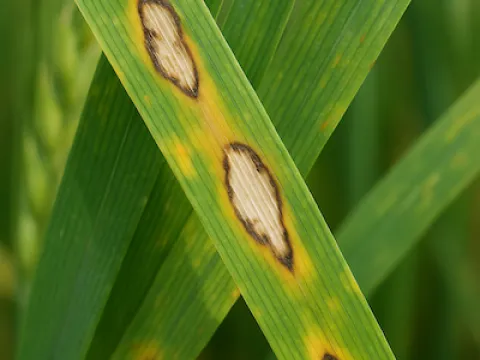
Rhynchosporium secalis
Rhynchosporium secalis
Rhynchosporium secalis is a pathogenic fungus that causes a disease commonly known as scald. It belongs to the class of imperfect fungi and specifically attacks members of the Poaceae family, primarily barley and rye.
What the section contains
Rhynchosporium secalis
The fungus survives between cropping seasons on infected crop debris, volunteer plants, and within contaminated seeds. This ability to persist in the field makes it a perennial threat to cereal production.
The primary inoculum consists of conidia, which are spread by rain splash and wind across the field. Once they land on a susceptible host, they germinate and penetrate the leaf surface to initiate infection.
In temperate climates, the fungus can overwinter in the mycelial stage on infected winter wheat or barley plants, serving as a reservoir for infection in the following spring.
Genetic diversity within the Rhynchosporium secalis population is significant, which often leads to the development of new strains capable of overcoming the resistance of older commercial cereal varieties.
Symptoms of scald appear as characteristic oval or lens-shaped lesions on the leaves and leaf sheaths. Initially, these spots are blue-green or water-soaked, eventually turning light gray with a dark brown margin.
As the disease progresses, the lesions enlarge and merge, often covering a large part of the leaf blade. This results in the browning and necrotic collapse of the leaf tissue.
Infected plants may show stunted growth and premature yellowing of the lower leaves. Under high humidity, a grayish fungal layer may appear on the lesions, representing active sporulation.
Unlike some other fungal blights, Rhynchosporium spots lack a prominent yellow halo, maintaining a fairly distinct boundary between healthy and infected green tissue.
In cases of severe infection, the disease can spread to the stem and the ear, causing physical deformity and reduced grain development, which directly impacts the crop's yield potential.
The development of Rhynchosporium secalis is strongly favored by cool and wet conditions. Temperatures ranging from 15°C to 20°C combined with high humidity are optimal for the pathogen.
Frequent rainfall and prolonged dew periods are critical for the dispersal of conidia and for the successful infection of host plants. Dry weather usually halts the progression of the disease.
Dense crop stands create a humid microenvironment that facilitates the spread of the fungus. Poor air circulation in such conditions allows the pathogen to establish itself more effectively on the lower canopy.
Excessive nitrogen fertilization often leads to lush, succulent plant growth, which provides an ideal nutritional substrate for the fungus, making the plants more susceptible to penetration.
Early sowing of winter cereals in a warm and wet autumn can increase the risk of early infection, as the fungus remains active as long as the temperature stays within its growth range.
The economic impact of scald is substantial, primarily due to significant yield loss. Infected fields often suffer from reduced grain weight and poor grain quality, resulting in financial losses for farmers.
By killing the leaf tissue, the fungus reduces the photosynthetic area of the plant, which hampers the grain-filling process and reduces the overall crop vigor.
Infected crops show increased susceptibility to secondary infections and environmental stresses, such as winter damage or drought, as the plants' natural defense mechanisms are weakened.
Yield losses can vary widely, but in cases of severe epidemics, farmers may face losses ranging from 15% to 30% of their potential harvest, necessitating costly control measures.
Furthermore, contaminated straw and grain pose challenges for animal feed and seed storage, potentially spreading the pathogen to previously unaffected fields.
Integrated disease management is essential to control Rhynchosporium secalis. This begins with good crop rotation, avoiding the continuous cultivation of barley or rye in the same field.
Proper tillage practices, such as burying crop debris, help to reduce the primary inoculum levels in the soil. Eliminating volunteer cereals is also critical to minimize infection bridges.
Choosing resistant or tolerant crop varieties is the most cost-effective long-term solution. Breeders work constantly to integrate resistance genes into commercial varieties to combat emerging pathogen strains.
Fungicide application remains the primary method for protecting crops during the growing season. Treatments should be timed according to local disease monitoring and threshold levels.
- Use of high-quality, treated seed material
- Balanced fertilization to avoid excessive vegetative growth
- Monitoring weather patterns to predict infection risks
- Rotation with non-host crops for at least two years