
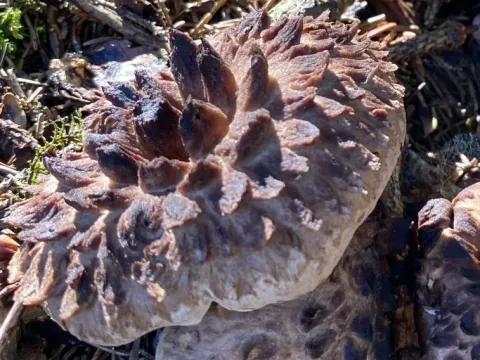
Scaly hedgehog
Sarcodon imbricatus
It is scientifically inaccurate to classify Sarcodon imbricatus as a plant disease or a pathogenic agent affecting crops.
What the section contains
Scaly hedgehog
In fact, this organism is a well-known mushroom species belonging to the Bankeraceae family, widely recognized for its edible qualities.
The fungus functions exclusively as a mycorrhizal symbiont, establishing a mutually beneficial relationship with the root systems of coniferous trees.
Unlike parasites that damage plant tissue, this fungus assists in the absorption of nutrients and water from the soil for the benefit of the host tree.
Therefore, there is no biological basis for considering this species a threat to plant health or a cause of agricultural decay.
The growth and development of the scaly hedgehog occur primarily in established coniferous forests where soil conditions are stable and moist.
Mycelial activity is most pronounced during late summer and autumn when temperature levels and precipitation support fungal fruit body emergence.
The fungus thrives in acidic soil environments and requires the presence of root systems from mature evergreen trees to complete its life cycle.
Disruption of the forest floor, such as intensive tilling or chemical fertilization, typically inhibits the growth of this specific species.
It acts as an indicator of a healthy, undisturbed forest soil ecology rather than an invasive pathogen.
The scaly hedgehog poses no harm to agricultural plants, trees, or forest health, and it requires no phytosanitary protection measures.
There is no evidence of the fungus causing necrosis, root rot, or any form of physiological stress to its host trees.
In forest management, the presence of such mycorrhizal fungi is viewed as a beneficial factor that promotes tree vitality and forest ecosystem resilience.
Because the fungus is a symbiont, it contributes to the overall nutrient cycling in the soil rather than depleting resources at the expense of plants.
Any attempt to manage or eliminate this fungus as a plant disease would be contrary to sustainable forest management practices.