
Scaly tooth
Sarcodon squamosus
Description
Pathogen
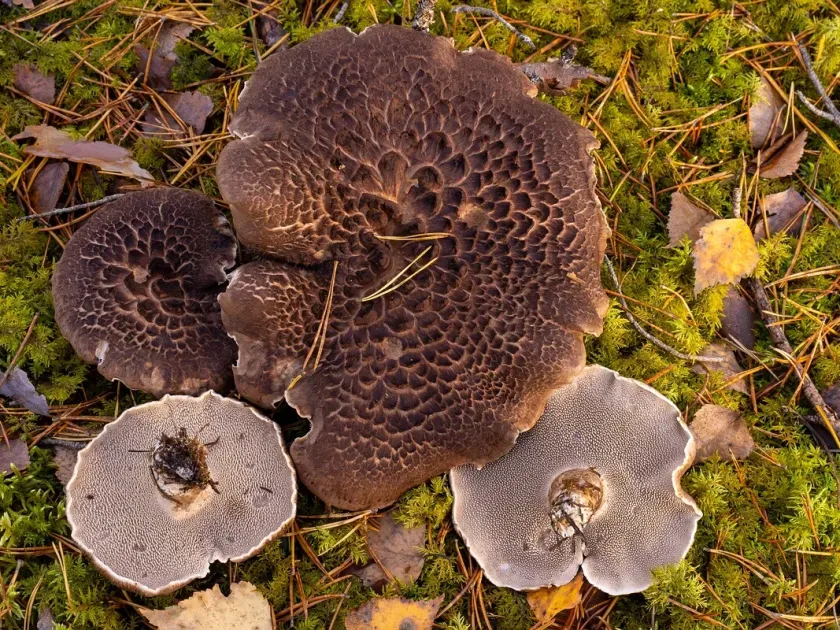
Scaly tooth (Latin: Sarcodon squamosus) is a basidiomycete fungus belonging to the Bankeraceae family. In a forest management context, it is recognized primarily as a mycorrhizal partner rather than a plant pathogen.
The organism forms complex symbiotic relationships with the root systems of pine species. While it is not a causative agent of plant disease, it is frequently studied in forestry to understand the health of coniferous soil micro-ecosystems.
Biologically, the fungus develops a dense mycelial network that colonizes soil horizons near tree roots. Its fruiting bodies are characterized by a brownish cap with large, prominent scales and a spine-covered hymenophore.
It occupies a specialized ecological niche, typically associated with mature coniferous forests. Its lifecycle is tightly coupled with the presence of host trees, indicating a long-term evolutionary connection.
The fungus is categorized within the Thelephorales order. Its enzymatic capabilities allow it to efficiently decompose specific organic matter, contributing to nutrient cycling in the forest.
Conditions for development
Scaly tooth thrives in undisturbed pine forests. It prefers sandy, well-drained soils that contain a thick layer of organic debris, essential for the maintenance of its mycelial network.
Environmental requirements include cool temperatures and high humidity during the late summer and autumn seasons. These conditions are necessary for the initiation and development of fruit bodies.
The species is highly sensitive to soil chemical changes. High levels of nitrogen fertilizers or pollutants act as inhibitors, rapidly leading to the decline of the mycelium.
Stability of the forest soil moisture is critical. Significant drops in water levels or extreme soil compaction can prevent the fungus from producing spores, effectively stopping its reproduction cycle.
Propagation is facilitated by basidiospores carried by air currents. Successful germination requires a specific chemical environment provided by the roots of the host pine trees.
Why it matters
Scaly tooth poses no harm to crops, ornamental plants, or agricultural production systems. It is strictly limited to forest ecosystems and does not behave as a parasite.
As a mycorrhizal fungus, it provides benefits to its host trees by enhancing water and nutrient absorption. This symbiotic function strengthens the vitality of forest stands against environmental stress.
There is no evidence that this species causes root rot, timber decay, or any necrotic tissue damage in trees. It is considered a beneficial component of the forest soil biota.
The presence of this fungus is often interpreted as a positive bio-indicator of a healthy, intact soil environment rather than a symptom of vegetation damage.
No agricultural economic impact is associated with this fungus. It does not threaten crop yields or the health of standard field plants.
Protection
No control measures are necessary for Sarcodon squamosus. Since it is not a plant pathogen, it should not be targeted with fungicides or chemical intervention.
Preventive strategies focus on the protection of natural habitats. Maintaining forest litter integrity and avoiding excessive soil disturbance are the best practices for the conservation of this species.
In forest management, monitoring is limited to ecological surveys. There is no requirement for eradication, as the species does not pose an economic or agricultural threat.
Avoid the use of intensive soil treatments near the base of pine trees, as these practices can irreparably damage the mycorrhizal network that supports the fungus.
General awareness of the species as a benign and beneficial forest resident is the only recommended approach, ensuring that management activities prioritize long-term ecological sustainability.
Discussion
No discussions yet — be the first.