
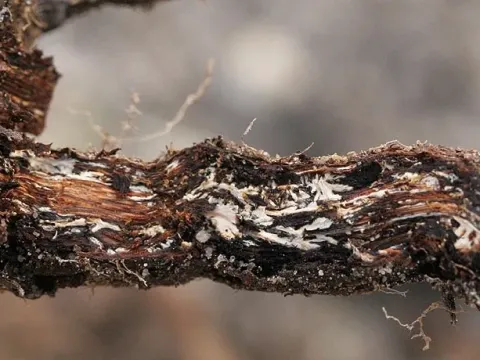
Rosellinia desmazieri
Rosellinia desmazieri
The causal agent of this disease is Rosellinia desmazieri, a member of the Xylariaceae family of ascomycetous fungi. This pathogen primarily targets plants within the genus Buxus (boxwood), acting as a parasite that colonizes the plant's bark and phloem tissues.
What the section contains
Rosellinia desmazieri
The fungus develops characteristic sexual fruiting bodies, known as perithecia, which appear as small, dark spots on the bark surface. These structures house the ascospores responsible for the dispersal of the fungus.
Once the spores land on a suitable host—often where the bark is already stressed or damaged—they germinate, and the fungal mycelium begins to invade the host tissue. The pathogen disrupts the plant's vascular system, hindering the flow of water and nutrients.
Rosellinia desmazieri can persist as a saprotroph on dead plant material, allowing it to survive in the environment and serve as a reservoir for infection. Its life cycle is perfectly adapted to the dense foliage of boxwood shrubs.
Environmental interactions are crucial for the pathogen’s biology, as it relies on specific levels of moisture and temperature to transition from a dormant state to an active, colonizing phase within the woody stems.
The earliest sign of infection is the appearance of small, clustered black dots on the bark, representing the fungal perithecia. These are often difficult to spot until the infection is well established.
As the mycelium colonizes the stem, the leaves above the affected area begin to turn dull, yellow, and eventually drop off. This foliage loss typically starts on individual branches before spreading to the entire shrub.
Peeling back the bark in the affected area reveals distinct necrotic patches on the underlying wood. These tissues usually turn a deep brown or black, signaling the death of the cambium layer.
Infected branches become brittle and lose their structural integrity. They often snap under light pressure or during windy weather, as the wood has been weakened by the progressive fungal rot.
During periods of high humidity, a faint, grayish or black mycelial mat may become visible on the surface of the bark, particularly in the lower parts of the shrub where moisture lingers longest.
High moisture levels are the most critical factor for the development of Rosellinia desmazieri. The fungus thrives in microclimates where air circulation is poor, such as dense boxwood hedges or shaded garden corners.
Extended periods of wet weather combined with temperatures between 15°C and 22°C create an ideal environment for spore germination and rapid mycelial growth within the host tissues.
Mechanical injuries, whether from pruning, heavy snow loads, or garden equipment, provide easy entry points for the pathogen. Once the bark barrier is breached, the fungus finds a nutrient-rich environment.
Over-irrigation, especially using overhead sprinklers that wet the foliage and stems late in the day, promotes the development of fungal infections by keeping the plant surfaces damp for too long.
Plants that are already under stress—due to poor soil nutrition, improper planting depth, or excessive shade—are significantly more susceptible to successful colonization by this fungal pathogen.
The primary damage caused by Rosellinia desmazieri is the loss of aesthetic value, which is particularly severe for boxwood given its slow growth rate. Recovery from branch loss can take years or even decades.
In severe cases, the pathogen reaches the main stem or crown, leading to the systemic death of the entire plant. This necessitates the removal and replacement of the shrub, disrupting landscape designs.
In mass plantings like hedges, the disease can spread rapidly from one plant to the next. If left unmanaged, a localized infection can quickly destroy an entire border, resulting in substantial financial losses.
The disease weakens the plant's overall vitality, making it more vulnerable to secondary pests and other pathogens. The energy drain caused by the fungal infection reduces the plant's resilience against environmental stress.
Management costs are high, involving repeated fungicide applications, specialized pruning tools, decontamination procedures, and the labor-intensive removal and disposal of infected plant material.
Rigorous sanitation is the cornerstone of control. All infected branches must be pruned back to healthy wood, and the debris should be removed from the site and burned or destroyed to prevent spore release.
Disinfecting pruning shears between cuts is mandatory to prevent the mechanical transmission of spores from infected sections to healthy parts of the same or neighboring plants.
Improving air circulation is essential for preventative care. Regular thinning and shaping help open the crown, allowing sunlight to penetrate and reducing the humidity that fungi rely on to grow.
Prophylactic treatments with copper-based fungicides or appropriate systemic fungicides can protect healthy plants during periods of high disease risk, such as wet spring or autumn seasons.
Maintaining optimal plant health through proper fertilization and watering practices ensures the boxwood is robust. A healthy shrub is far better equipped to seal off wounds and resist fungal invasion naturally.