
Rosellinia root rot
Rosellinia
The disease is caused by fungi of the Rosellinia genus, most notably Rosellinia necatrix, known as white root rot, and Rosellinia bunodes.
What the section contains
Rosellinia root rot
These pathogens are soil-borne fungi that primarily attack the woody root systems of perennial plants, causing severe decay and necrosis.
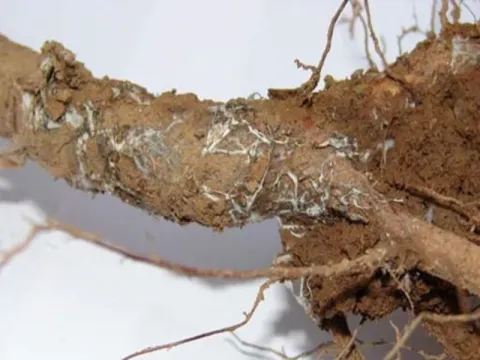
The fungus produces white or greyish mycelial strands, known as rhizomorphs, which travel through the soil to infect the root systems of healthy adjacent plants.
Reproduction occurs through both asexual spores (conidia) and sexual spores (ascospores), allowing the pathogen to disperse effectively across a plantation.
The fungus survives for many years in the soil by colonizing organic debris, old roots, and stumps, making it a persistent threat to agricultural fields.
The initial signs of infection are often subtle and manifest as slight wilting or yellowing of the foliage, which can be easily mistaken for nutrient deficiency.
As the disease progresses, the plant shows rapid wilting, followed by leaves turning brown and dropping, as the root system loses its functionality.
An inspection of the root collar reveals the characteristic white, star-shaped fungal mycelium spreading across the bark and inner tissues.
The bark of the roots eventually decays, turning black and mushy, and the tissue beneath becomes spongy and fragile when touched.
In mature coffee plantations, infected trees often appear in patches, with the disease radiating outward from the original point of infection.
The development of Rosellinia is strongly favored by cool to moderate temperatures and high soil moisture levels, common in shaded or low-lying areas.
Compacted, poorly drained soils create an environment that encourages the growth of the fungus while stressing the host plant's root system.
High humidity and consistent rainfall contribute to the rapid spread of spores and the movement of mycelial strands through the soil profile.
The presence of decaying organic matter, such as woody residues from previous forest clearing, provides a vital food source for the pathogen to establish itself.
Frequent contact between the roots of adjacent trees facilitates the transmission of the fungus across a plantation, leading to large-scale outbreaks.
Rosellinia root rot is a highly damaging disease for Arabica and Robusta coffee, frequently leading to the total collapse of mature producing trees.
By destroying the root system, the fungus prevents the plant from absorbing necessary nutrients and water, leading to inevitable wilting and plant death.
The pathogen causes significant economic losses due to the permanent destruction of coffee stands and the lengthy quarantine periods required for soil recovery.
Because the disease often goes undetected until significant root damage has occurred, recovery of an infected plant is rarely possible.
Persistent presence in the soil limits the use of infected land for future planting of sensitive crops for several years.
Effective management requires the removal of infected plants including the entire root system to prevent further spread of the mycelium.
Infected sites should be isolated and treated with soil solarization or appropriate fungicides to reduce the inoculum level in the soil.
Improving field drainage is critical, as well as ensuring that no woody debris or old roots remain in the soil before planting new crops.
Biological control using antagonistic organisms, such as Trichoderma species, has shown promise in suppressing the pathogen's growth in the soil.
Regular monitoring of the field and immediate removal of any tree showing early symptoms of decline is essential for limiting the damage to the plantation.