
Rhizodiscina lignyota
Rhizodiscina lignyota
Description
Symptoms
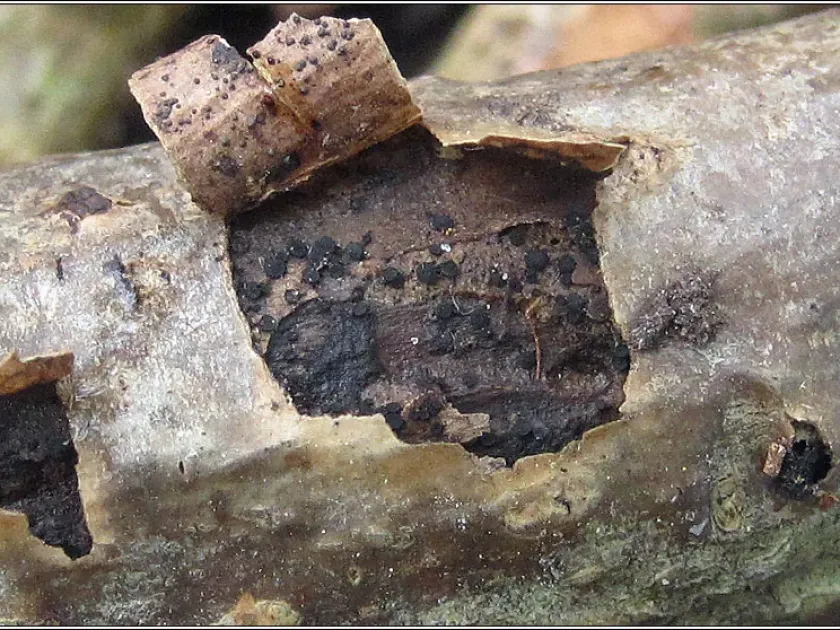
The most visible sign of an infection is the appearance of tiny, black, disc-shaped apothecia clustered on the bark surface.
Affected bark areas often exhibit signs of necrosis, with the tissue becoming darkened, brittle, and prone to cracking as the infection progresses.
In advanced stages, the fungal mycelium can be observed deep within the bark layers, often causing the surface to flake or peel away.
Symptoms are most pronounced during damp, humid weather when the fungal fruiting bodies absorb moisture and become clearly visible to the naked eye.
Infection often starts in crevices or wounded areas, making these locations the primary diagnostic focus for early detection.
Pathogen
Rhizodiscina lignyota is an ascomycete fungus belonging to the order Helotiales. It is primarily known as a wood-decaying fungus that thrives on dead or weakened woody tissues.
The fungus develops small, dark-colored fruiting bodies known as apothecia, which emerge from the bark or wood surface when conditions are suitable for reproduction.
Biological research indicates that this species acts as a decomposer, breaking down complex organic compounds like lignin in decaying plant matter.
The spread of the pathogen is primarily facilitated by ascospore dispersal, which allows the fungus to colonize new susceptible hosts via wind and water splashing.
While often found on dead wood, under specific stress conditions for the host plant, the fungus can extend its activity to living, weakened tissues.
Conditions for development
The development of Rhizodiscina lignyota is highly dependent on environmental moisture levels, with high relative humidity being essential for optimal growth.
Shaded environments, which retain water on bark surfaces for extended periods, provide an ideal microclimate for the establishment of the fungus.
Plants weakened by environmental stress, such as drought, frost, or mechanical damage, are significantly more susceptible to colonization.
Dense canopies that prevent rapid drying of branches after rainstorms increase the likelihood of successful spore germination and mycelial spread.
The fungus is most active during cooler, wet months, which corresponds with the peak period for apothecia maturation and spore release.
Why it matters
The primary harm caused by this fungus is the accelerated degradation of bark tissue, which impairs the tree's natural defense mechanisms.
Weakened bark serves as an entry point for more aggressive secondary pathogens and wood-boring insects, further compromising the host's health.
In ornamental plants, the presence of the fungus significantly diminishes visual appeal, leading to localized dieback of branches and twigs.
Persistent infestation can lead to stunted growth and reduced vigor in trees that are otherwise trying to recover from ecological or climatic stress.
Although it is not typically a primary pathogen of healthy trees, its presence indicates underlying health issues that require management attention.
Protection
Effective control starts with sanitation: removing dead or dying branches and clearing surrounding plant debris is essential to reduce the inoculum load.
Pruning should be performed to improve canopy ventilation, which lowers humidity levels around the stems and discourages fungal growth.
Any mechanical injuries or wounds to the bark should be treated with appropriate pruning sealers or copper-based fungicides to prevent infection.
In cases of significant infestation, chemical control using systemic or contact fungicides targeting ascomycetes can be employed as a management strategy.
- Maintain high plant vigor through proper fertilization and watering.
- Conduct regular inspections of bark and branch junctions.
- Dispose of infected wood by burning or deep burial to eliminate spore sources.
Discussion
No discussions yet — be the first.