
Rinodina
Rinodina
Rinodina is a genus of crustose lichens belonging to the Physciaceae family. In agricultural terms, it is frequently misidentified as a plant disease, but it is actually an epiphyte that lives on the surface of tree bark.
What the section contains
Rinodina
The organism is a symbiotic association between a fungus and algae. It uses the tree surface merely as a substrate for attachment and does not act as a parasitic pathogen.
These lichens do not extract sap or nutrients from the tree. Instead, they derive their nutrition from the atmosphere, rain, and accumulated dust on the bark surface.
Because they are highly sensitive to environmental conditions, their presence is often an indicator of local air quality and the general microclimate of the orchard.
While they are not true pathogens, they are often considered undesirable in commercial orchards due to their role in creating hiding spots for various pests.
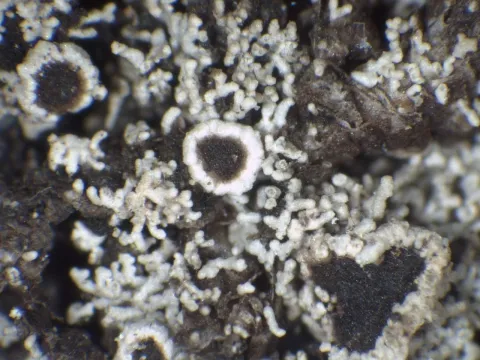
The primary symptom is the presence of crust-like patches on trunks and branches, which may be gray, brown, or greenish. The texture can vary from smooth to granular.
Upon close inspection, you may see tiny, disc-like structures known as apothecia. These are the fruiting bodies of the fungal component, appearing as small dark spots.
Lichens are most commonly found on the shaded or wetter sides of trunks, where light levels are lower and moisture persists for longer periods throughout the day.
Unlike true bark diseases like cankers or bacterial rot, the bark underneath the lichen colony remains healthy, flexible, and free of lesions or necrotic tissue.
The growth of the lichen is usually slow and seasonal, and it does not penetrate deep into the phloem or cambium layers of the host plant.
High humidity and consistent moisture are the primary drivers for the establishment and growth of Rinodina colonies on trees within an orchard setting.
Orchards with dense canopy cover, which limits airflow and prevents the bark from drying out after rainfall, are particularly prone to colonization by lichens.
Older trees with rough, weathered bark provide more niches for lichen spores to settle, which is why older orchards often exhibit more growth than younger plantations.
Lack of proper pruning and canopy management prevents sunlight from reaching the trunk, creating the dark, humid environment that lichens require for expansion.
Poor orchard sanitation, including the neglect of scraping dead or loose bark, provides a stable, long-term habitat for the development of these epiphytic organisms.
The main risk associated with lichen growth is that it provides excellent shelter for overwintering pests, including scale insects, mites, and their eggs, making control difficult.
Heavy coverage of lichen on the trunk can theoretically interfere with gas exchange in the bark, although this effect is typically negligible on otherwise healthy trees.
The visual presence of lichens can often obscure the symptoms of true tree diseases, such as fungal infections or pest damage, hindering early detection and treatment.
In some scenarios, lichens can hold excessive moisture against the bark surface, potentially creating a micro-environment that encourages secondary wood-rotting fungi.
While not lethal, a heavy infestation often indicates a decline in maintenance practices, which can indirectly lead to reduced tree vigor and overall productivity.
Manual cleaning of the bark using soft metal brushes or wooden scrapers is the most direct and effective way to remove lichens without harming the living tissues.
Applying a whitewash mixture (lime mixed with copper sulfate) to the trunks serves as a traditional and effective method to sanitize the surface and inhibit lichen spore germination.
Spraying the trees with a 3–5% solution of ferrous sulfate (iron sulfate) during the dormant season is highly effective at killing the lichen, causing it to flake off naturally.
- Thinning the tree canopy to increase light and airflow.
- Removing dead wood and maintaining good sanitation.
- Improving overall tree health through proper fertilization.
- Scraping bark during wet weather when lichens are softer.
Regular fungicide applications, when required for managing actual fungal diseases, often result in a significant decrease in lichen populations on treated branches and stems.