
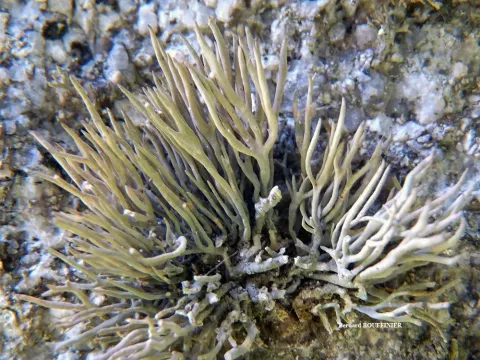
Roccella fuciformis
Roccella fuciformis
It is important to clarify that Roccella fuciformis is not a plant pathogen or a disease of crops. It is a biological species of lichen belonging to the Roccellaceae family.
What the section contains
Roccella fuciformis
This organism is a symbiotic complex of a fungus and an alga. It typically inhabits coastal cliffs and rocky areas in regions with a stable maritime climate.
Botanically, it is a fruticose (shrub-like) lichen with a greyish-white or pinkish thallus. It does not exhibit parasitic properties and does not affect the health of agricultural crops.
This species is not the cause of any infectious or non-infectious plant diseases. Its presence on tree bark or rocks is ecologically safe for the surrounding vegetation.
In agronomic practice, this organism is not considered a threat, as it does not compete for nutrients with crops and does not secrete toxins that could damage plants.
For the survival of Roccella fuciformis, high atmospheric humidity and clean air, free from industrial pollutants and gases, are critically important.
The lichen prefers rocky substrates that are warmed by the sun but remain protected from extreme desiccation by maritime breezes.
The development of the species is extremely slow, which is typical for the metabolism of lichenized fungi in specific climatic niches.
The optimal habitat is restricted to coastal zones where salt content in the air and humidity create ideal conditions for thallus formation.
Any disruption of the ecological balance, particularly human-induced pressure, leads to the disappearance of this species, highlighting its sensitivity to environmental changes.
Roccella fuciformis poses no threat to agricultural production. Describing this organism as a plant disease is a misconception with no scientific basis.
Historically, the species had significant economic value as a source of natural dye, such as orcein, which was widely used in the textile industry before the advent of synthetic alternatives.
Furthermore, this lichen was traditionally used to produce litmus, an essential acid-base indicator used in chemical laboratories worldwide.
There are no control measures required for this species, as it is an ecologically valuable natural element that should be conserved rather than eliminated.
Cultivation of crops in areas where this lichen is present is completely safe, as Roccella fuciformis does not interact with agricultural plants.