
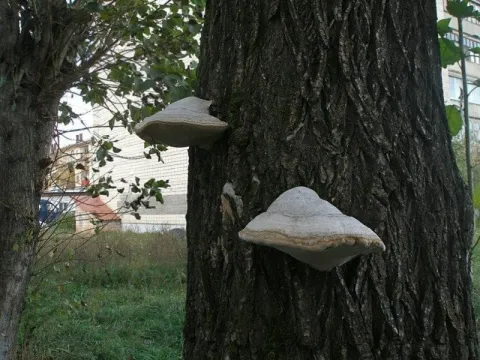
Robust Oak Conk
Phellinus robustus
The Robust Oak Conk (scientific name Phellinus robustus) is a wood-decay fungus belonging to the Hymenochaetaceae family. It acts as a primary pathogen causing heartwood decay in various hardwood tree species, most notably oaks.
What the section contains
Robust Oak Conk
The fungus is a perennial, wood-rotting parasite that develops hard, hoof-shaped fruiting bodies on the stems of affected trees. These fruiting bodies are extremely durable and can persist on the bark for many years, continuously releasing spores.
The infection typically begins when fungal spores enter the tree through open wounds, frost cracks, or areas where branches have broken off. Once inside, the fungus invades the heartwood, secreting enzymes that break down the lignin and cellulose matrix of the wood.
Unlike some pathogens that kill trees rapidly, this fungus grows very slowly. It colonizes the interior of the stem over several decades, often leaving the outer sapwood relatively unaffected until the late stages of decay.
The internal degradation caused by Phellinus robustus leads to a characteristic white rot. As the structural integrity of the heartwood is lost, the tree becomes hollowed out from the inside, significantly weakening the trunk's mechanical stability.
The most visible diagnostic sign of this fungus is the presence of the woody, perennial fruiting body. These conks are often gray-brown or black, hard, and exhibit a distinctly cracked surface, resembling a hoof.
Internally, the fruiting body features a rusty-brown pore surface. When a tree is severely infected, the wood at the site of decay displays advanced white rot, often demarcated by thin, dark-colored lines within the wood.
Affected trees may show signs of canopy decline, such as premature yellowing of leaves or the presence of dead branches (dieback). These symptoms often go unnoticed by those not trained in phytopathology, as they can be mistaken for general drought stress.
Deformation of the trunk or bark at the point where the conk is attached is common. In advanced cases, the stem may bulge or crack due to the loss of internal support as the wood decomposes.
Another warning sign is the sudden structural failure of a tree during mild wind events. Since the exterior may appear healthy, the failure is often attributed to the unseen core rot caused by this specific fungus.
The development of Phellinus robustus is heavily dependent on moisture and temperature. Spore germination and colonization occur best in humid environments, with temperatures between 18 and 25 degrees Celsius being optimal.
Tree age is a major factor in the disease's prevalence. Mature and over-mature trees, which are more likely to have accumulated environmental wounds and bark damage over the decades, provide the necessary entry points for the fungal spores.
Dense, poorly managed forest stands create a stagnant microclimate that encourages the survival and dispersal of fungal spores. Lack of airflow prevents bark from drying quickly, further facilitating infection.
The fungus spreads primarily through airborne spores. Once these spores land on a vulnerable wood surface, they utilize moisture and the tree's internal nutrients to establish a new mycelial colony.
The presence of logging debris, old stumps, and neglected deadwood within a forest provides a persistent reservoir for the pathogen, ensuring that nearby healthy trees remain at constant risk of infection.
The Robust Oak Conk causes significant damage to forestry, particularly in oak and beech stands. Its impact is measured in the loss of high-quality timber and the reduction of forest economic value.
Because the fungus destroys the valuable heartwood, trees infected by it are often rejected for high-grade lumber production. This leads to substantial financial losses for timber producers and forest managers.
Beyond economic impact, the disease reduces the overall resilience of the forest ecosystem. Infected trees are more prone to secondary infestations by wood-boring insects, which accelerate the total death of the tree.
In urban and recreational settings, this fungus is a major safety concern. A tree that appears structurally sound but is internally hollow due to stem rot poses a serious risk of falling on people or property.
The disease effectively shortens the lifespan of host trees, disrupting the ecological role of these large, old-growth specimens in maintaining biodiversity within the forest structure.
The most effective management strategy is rigorous sanitation. Foresters should prioritize the removal of trees showing fruiting bodies to reduce the overall spore load within the stand.
Minimizing mechanical injury to standing timber during forestry operations is essential. Any wounds created by machinery or natural disasters should be protected to prevent immediate fungal colonization.
Maintaining tree vigor through appropriate silvicultural practices, such as proper thinning and ensuring adequate water and nutrient levels, helps trees resist the progression of wood-decay fungi.
In parks and residential areas, expert tree inspections are required to identify hidden rot. If an established conk is found, the tree is typically considered structurally compromised and should be professionally removed.
- Remove infected trees exhibiting fruiting bodies.
- Treat and seal mechanical wounds on valuable trees.
- Clear forest debris and stumps to limit spore sources.
- Monitor mature tree health via regular arboricultural assessments.
- Prevent bark damage during forest management activities.